


Last updated: August 19, 2026
Subhapruek Golf Club is an 18-hole, par-72 course in the Bang Bo district of Samut Prakan. It was designed by Pete Dye, the credit the club itself gives; some sources also name his son Perry Dye. It measures about 6,837 yards from the back tees, 6,013 from the club tees and 5,249 from the front.
The name Pete Dye occupies a particular place in the history of golf architecture. He created the 17th at TPC Sawgrass — the island green surrounded by water — and established a way of designing that makes you tense the moment you see it. That thinking is clearly stamped on Subhapruek too.
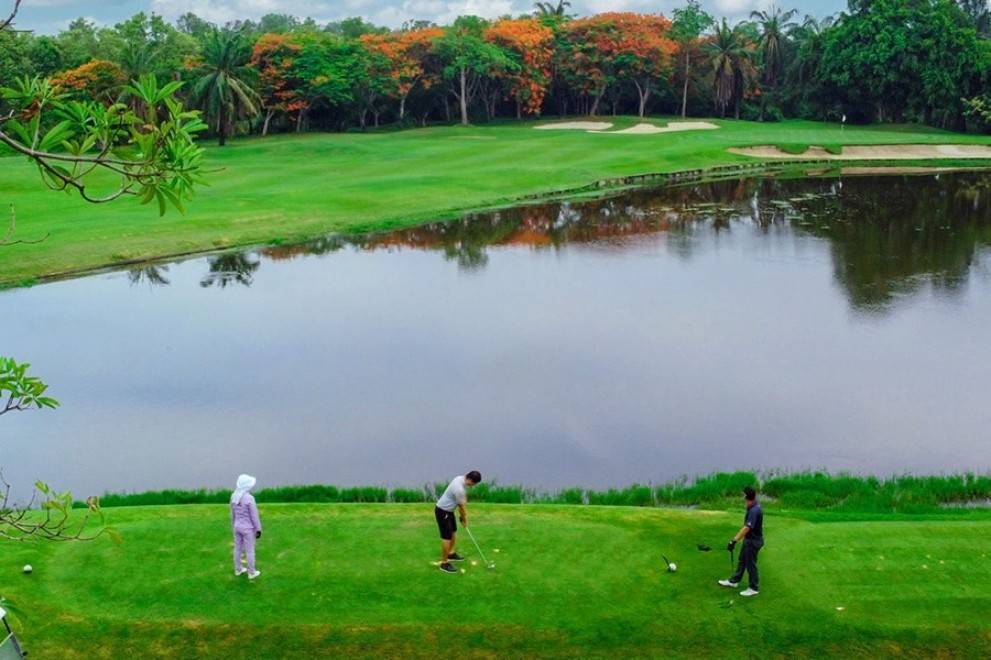
It opened in 1993, originally as Bangna Country Club, and was renamed Subhapruek in 1995. What had been flat, marshy rice fields was given abundant bunkering and water set to run alongside the fairways.
And the closing three holes are where the course comes into its own: the rock-edged island green at the 16th, the 17th that wraps around a lake, and the 18th that finishes beside an ornamental waterfall. There is even a bonus par-3 19th. Check today’s tee times and rates on the GoGolf app or website.
Rates and booking
Green fees vary by day of the week, public holidays, season and timing. The rates shown on GoGolf reflect these in real time as closely as possible, so please check the GoGolf app or website for current pricing.
Price summary
Green fee + cart, per playerTHB2.150to3.350
| AM from | PM from | |
|---|---|---|
| Weekday | THB 2.150 | THB 2.150 |
| Weekend & holiday | THB 3.350 | THB 2.500 |
Price calendar
23 Oct – 18 Nov 2026 · THBWeekend & holiday rateNo tee timesM = million THB, lowest of each half-day
Book more easily with the GoGolf app


Course information
| Location | 102 Village No. 7, Bangna-Trad Road Km. 26, Bang Bo, Samut Prakan 10560 |
|---|---|
| Designer | Pete Dye (the club’s own credit; some sources also name Perry Dye) |
| Opened | 1993 (originally Bangna Country Club; renamed Subhapruek in 1995) |
| Holes | 18 holes, par 72 (plus a bonus par-3 “19th”) |
| Length | Back about 6,837 yards / Club about 6,013 yards / Front about 5,249 yards |
| Course type | Open parkland fringed with trees; gentle movement and easy walking |
| The land | Originally flat, marshy rice fields |
| Defining features | Abundant bunkering and water running alongside the fairways, with the weight of water rising towards the finish |
| Signature holes | The par-3 16th, a rock-edged island green / the par-4 17th, wrapping around a lake / the par-4 18th, finishing beside a waterfall |
| Practice | Practice facilities available |
| Clubhouse | International cuisine |
| Caddies and carts | A caddie is compulsory. Carts available for hire |
| Spikes | Non-metal spikes only |
| Telephone | +66 2 705 6262 |
| Official site | subhapruekgolf.com |
| Rates | Vary by day, season and tee time. Check current rates on the GoGolf app or website |
Pete Dye, the architect
Pete Dye is one of the figures who changed golf course architecture most in the second half of the twentieth century.
What made his name definitively was the island green at the 17th at TPC Sawgrass in Florida. A small green completely surrounded by water. Short in distance, with nowhere at all to bail out. The idea is to test the mind rather than the technique.
Making it hard by showing it
What runs consistently through Dye’s designs is a method of not hiding the danger but emphasising it. Railway sleepers, rock, white sand. By making the outline of a hazard clearly visible, he concentrates your attention on it.
And people are drawn towards the thing they are trying to avoid. The more conscious you are of the water, the more the ball goes there. Dye built that psychology into course design.
The Dyes, a family of architects
The club credits the design of Subhapruek to Pete Dye; some sources also name his son Perry. The Dyes are known as a family of golf architects: his wife Alice and his sons Perry and P.B. have all been involved in design.
The land was originally flat, marshy rice fields. Placing abundant bunkering and water on it to create visual tension — characteristically Dye work has been done here too.

The design of the closing three holes
What stands out most in the shape of Subhapruek is the run from the 16th to the 18th. The weight of water is designed to rise as you approach the finish.
The 16th: a rock-edged island green
The par-3 16th has a green surrounded by water, its edge faced with rock. Edging in rock is a treatment characteristic of Dye’s work.
The effect of the rock is plain: you can see exactly where the water’s edge is. With no ambiguity, the distance is easier to calculate. But it also draws a clear line saying: miss this and you are finished.
Playing it well comes down to matching the distance. The tighter the pin is cut to an edge, the more certain it is to aim at the centre and take two putts.
The 17th: a par 4 around the lake
The 17th is a par 4 laid out to wrap around a lake. Cut the corner and you gain distance, but you move closer to the water.
Whether you protected your score at the 16th affects the decision here. Straight after dropping a shot at the 16th, you want it back at the 17th. That psychology is exactly what Dye is aiming at. The question is whether you can lay up calmly.
The 18th: finishing beside a waterfall
The closing 18th ends beside an ornamental waterfall. As a piece of visual staging it is about as good as it gets, and it makes for a scene that stays with you after the round.
Three consecutive holes that put you face to face with water, then a waterfall to close. Condensing the story of the whole eighteen into the finish is this course’s design intent.
The bonus “19th”
Subhapruek has a par-3 “19th” in addition to the eighteen.
It does not count towards your official score — it is an extra hole. In practice, though, it works as entertainment when you are playing in a group.
Settling a tie, answering the urge to hit just one more, or simply providing something to bet on. That refusal to end at eighteen captures the atmosphere of this course well.
Location and access
Subhapruek is in the Bang Bo district of Samut Prakan. As the address says — Bangna-Trad Road Km. 26 — it sits at the 26-kilometre point of Bangna-Trad Road.
That road is the axis along which the courses of Samut Prakan are concentrated. Ballyshear Golf Links is nearby, and closer to the centre lie Lakewood, Green Valley and Muang Kaew. Being able to build an itinerary around several courses is a real advantage of the area.
For transport, use a company car or your own vehicle, or a ride-hailing service such as Grab, which is common in Bangkok. From the city centre the route uses the expressway and Bangna-Trad Road, and journey time varies with traffic. At the 26-kilometre point, we recommend leaving with time in hand.
Being a course on the outskirts, it is worth planning the trip home in advance too. Please note that GoGolf does not arrange transfers or shuttles.

How to think about scoring
The key to scoring on a Dye course is not letting the visual pressure distort your judgement.
- When you see water, check the distance first. Judge by numbers rather than instinct and the pressure drops.
- Aim at the centre of the green at the 16th. There is no reason to attack a pin on an island green.
- Do not try to win it back at the 17th. Carrying a mistake from the 16th leads to losing shots in succession.
- Plan around avoiding the bunkers. There are many of them, so not going in is the best defence.
- Keep something in reserve for the finish. The 16th to the 18th demand judgement, so do not exhaust yourself early.
- Bring plenty of spare balls. With water running alongside the fairways, that is simply realistic.
At about 6,837 yards from the back tees it is not overly long by the standards of courses around Bangkok. This is a course you compete on with judgement rather than distance. The club tees drop to about 6,013 yards and the front tees to about 5,249.
Common mistakes, and how to avoid them
1. Finding the water because you were thinking about it
This is the most common mistake on a Dye course. The harder you think “I must not go in”, the tighter you get, and the shot that comes out is not your usual one.
The remedy is to change what your attention is on. Not “avoid the water” but “carry it to the middle of the green”. In the same situation, the body works more freely with a positive target.
2. Attacking the pin at the 16th
There is almost never a reason to attack a pin on an island green. Think only about finding the surface. Accept that two putts is enough and the hole stops being unreasonable.
3. Losing your judgement late in the round
The 16th to the 18th are where this course demands the most judgement. They are also when you are most tired. Not forcing it early, and taking water and rest regularly, protects your score at the finish.
4. Taking the bunkers lightly
This course has plenty of bunkers. No single one is fatal, but over eighteen holes they add up to several shots. Checking the distance to the bunker from the tee and choosing a club that will not reach it is a useful decision.
Facilities and service
Clubhouse and food
The clubhouse serves international cuisine. It is easy to suit everyone in a group, so the meal after the round happens in the same place.
Practice
There are practice facilities for loosening up before the round. With so many decisions about carrying water, confirming your carry distance before you start leaves you less hesitant on the 16th tee.
Caddies and carts
A caddie is compulsory. They can tell you the distance to the water’s edge and where the bunkers sit — things that are hard to judge on a first visit. Carts are available for hire.
The spike rule
Non-metal spikes only.
What to bring
- Spare balls — with water running alongside the fairways, bring more than you think.
- Sunscreen and a hat — essential.
- Non-metal spiked shoes — metal spikes are not permitted.
The best season and time of day
The dry season from about November to February is the most comfortable: humidity drops, and mornings and evenings can feel genuinely cool. It is also the season when the water looks at its best.
In the hot season from March to May the daytime temperature climbs, so an early start keeps the toll down. Because this course demands judgement late in the round, choosing a time that leaves you with energy matters a good deal.
The rainy season from June to October is mostly a short afternoon squall passing through. A morning round is less affected, and tee times are comparatively easy to get. After rain the water level can rise, though, so judge your carries more carefully.
Who this course suits
- Golfers who choose by architect: a chance to play a Pete Dye design near Bangkok.
- Anyone who wants to play an island green: the rock-edged 16th is the shot you will remember from the day.
- Anyone testing their judgement: the choice between attacking and laying up decides the result, not distance.
- Improving players: the front tees are a modest 5,249 yards, so it plays comfortably from the right tee.
- Groups and competitions: an international clubhouse menu and a “19th” to settle things.
- Anyone planning several rounds: on Bangna-Trad Road, it combines easily with neighbouring courses.
On the other hand, if the pressure of a water carry troubles you, the finish may feel severe. That is exactly when moving up a tee and planning to lay up lets you play it without losing what makes the course interesting.

How it differs from other courses in Samut Prakan
The courses along Bangna-Trad Road have distinctly different characters. To place Subhapruek among them, it helps to set it beside the other courses in the area bookable through GoGolf.
What is distinctive here is the concentration on the finish. Rather than being evenly difficult across eighteen holes, the story is condensed into the 16th, 17th and 18th. How the round stays in your memory is different from other courses.
Combining it with other courses in Samut Prakan
If you are playing several rounds during your stay, pairing this with neighbouring courses keeps the travel down.
- Ballyshear Golf Links — nearby in the same Bang Bo district, a much-discussed Gil Hanse design.
- Lakewood Country Club — 27 holes, recombined for a different round each time.
- Muang Kaew Golf Course — closer to the centre, with raised greens as its feature.
- Green Valley Country Club — a course with striking sleeper-faced bunkers.
Availability and rates for the whole area are on the Samut Prakan golf booking page.
In summary
The case for Subhapruek comes down to three things.
- The design — by Pete Dye, using a method that emphasises the danger rather than hiding it.
- The closing three holes — the rock-edged island green at the 16th, the 17th around the lake, and the 18th finishing at a waterfall.
- The playfulness — a bonus par-3 “19th”, and the idea of not ending at eighteen.
Subhapruek Golf Club opened in 1993 (originally Bangna Country Club, renamed in 1995): 18 holes, par 72, about 6,837 yards from the back tees. It is not excessively long, and it is a course you compete on with judgement rather than distance.
If you want to play an island green in Thailand, or to experience a Dye design, this is a strong option near Bangkok. Check today’s tee times and rates on the GoGolf app or website.
Frequently asked questions
Where is Subhapruek Golf Club?
How many holes is it, and what is the par?
Who designed the course?
When did it open? I heard the name changed.
Which are the signature holes?
How should I attack the island green at the 16th?
Where is the difficulty?
What is the “19th”?
Can a beginner play here?
Is there a driving range?
Can I eat there?
What about caddies and carts?
What is the best season and time of day?
How much does it cost?
Is there a transfer service?
More Golf Courses in Samut Prakan
Swipe to see more courses →