


Last updated: August 19, 2026
Ballyshear Golf Links (Ban Rakat Club) is an 18-hole, par-71 course in the Bang Bo district of Samut Prakan. It was designed by Gil Hanse and opened in October 2021, measuring a little over 7,000 yards from the back tees, with two nines that both return to the clubhouse.
What makes this course special comes down to one thing: it sets out to recreate a great course that no longer exists. The model is the Lido Golf Course, once on Long Island, New York. Built by Charles Blair Macdonald and Seth Raynor, it was called one of the greatest ever — and then it was lost. Gil Hanse reinterpreted Lido’s holes on this piece of ground.
Eden (the 3rd), Channel (the 4th), Cape (the 5th), Biarritz (the 8th), Redan — template holes that hold a place in the history of golf architecture line up here, and the 17th is a 605-yard Long. In other words, this is a place near Bangkok where you can walk through a textbook of classical architecture in a single round.
The land is the site of the former Kiarti Thanee Country Club. Flat Thai ground has been given links-style shaping and firm, fast greens. Gil Hanse is also the architect who built the golf course for the 2016 Rio de Janeiro Olympics. Check today’s tee times and green fees on the GoGolf app or website.
Green fees and booking
Green fees vary by day of the week, public holidays, season and timing. The rates shown on GoGolf reflect these in real time as closely as possible, so please check the GoGolf app or website for current pricing.
Price summary
Green fee + cart, per playerTHB5.750to7.750
| AM from | PM from | |
|---|---|---|
| Weekday | THB 5.750 | THB 5.750 |
| Weekend & holiday | THB 7.750 | THB 7.750 |
Price calendar
7 Oct – 3 Nov 2026 · THBWeekend & holiday rateNo tee timesM = million THB, lowest of each half-day
Book more easily with the GoGolf app


Course information
| Address | Ban Rakat Subdistrict, Bang Bo District, Samut Prakan 10560 (on Bangna-Trad Road) |
|---|---|
| Designer | Gil Hanse |
| Opened | October 2021 |
| Holes | 18 holes, par 71 (two returning nines) |
| Length | Over 7,000 yards from the back tees |
| Concept | A tribute to the lost Lido Golf Course (C.B. Macdonald / Seth Raynor) |
| Template holes | 3rd Eden / 4th Channel / 5th Cape / 8th Biarritz / Redan / 17th Long (605 yards) |
| Land | The site of the former Kiarti Thanee Country Club |
| Greens | Maintained towards firm and fast conditions |
| Phone | +66 2 060 8500 |
| Green fees | Vary by day, season and time slot. Check current rates on the GoGolf app or website |
What the lost Lido actually was
To understand Ballyshear you have to start with the Lido Golf Course.
Lido was built on Long Island, New York, in the 1910s. It was designed by Charles Blair Macdonald and Seth Raynor, and it was born from the idea of transplanting the great holes of British links courses onto artificial ground reclaimed from marsh.
It was rated extremely highly at the time; the record shows it being called one of the finest courses in the world. But Lido was lost in the wake of the Second World War and no longer exists. Only photographs, plans and written descriptions remain — a phantom course.
In recent years attempts to recreate Lido have been made in various parts of the world, and Ballyshear belongs to that movement. It is not a complete replica, though: Gil Hanse interpreted Lido’s holes and rebuilt them to suit the conditions of this land. That is exactly what makes it more interesting than mere imitation.
The idea of the template hole
Whenever the work of Macdonald and Raynor comes up, the concept of the template hole comes with it.
The method is to extract the design skeleton of a famous hole on a British links and reconstruct it on different ground. It is not about making a photographic copy; it is about taking out the reason that hole is interesting and transplanting that. So the same template looks different at every course.
The templates identifiable at Ballyshear are as follows.
- 3rd, Eden — a par 3 whose model is the 11th at the Old Course, St Andrews. The slope of the green and the bunker short of it are what bite.
- 4th, Channel — a hole heavily involved with water. You decide for yourself how much to carry.
- 5th, Cape — a hole played to a green on a headland. The more you take on, the shorter the route; miss and you lose. Classic risk and reward.
- 8th, Biarritz — the famous form, with a deep swale running through the middle of a very long green. Land it short and two putts become difficult.
- Redan — a green set on the diagonal with a bunker short of it. You use the slope to feed the ball from right to left; the byword for a strategic par 3.
- 17th, Long — a 605-yard par 5, where the distance itself is the test.
For anyone interested in golf architecture, the simple fact that these names line up within one round is reason enough to come. And for anyone who is not interested, each hole still presents itself as a straightforwardly interesting problem.
Gil Hanse the architect
Gil Hanse, who designed the course, is one of the most highly regarded golf architects working today. Designing the course for the 2016 Rio de Janeiro Olympics made his name known well beyond the golf industry.
What runs through Hanse’s work is a deep understanding of the classics. Rather than competing on novelty, he reads what the great designs of the past intended and makes it work under modern conditions. Ballyshear may be the project where that attitude appears most directly.
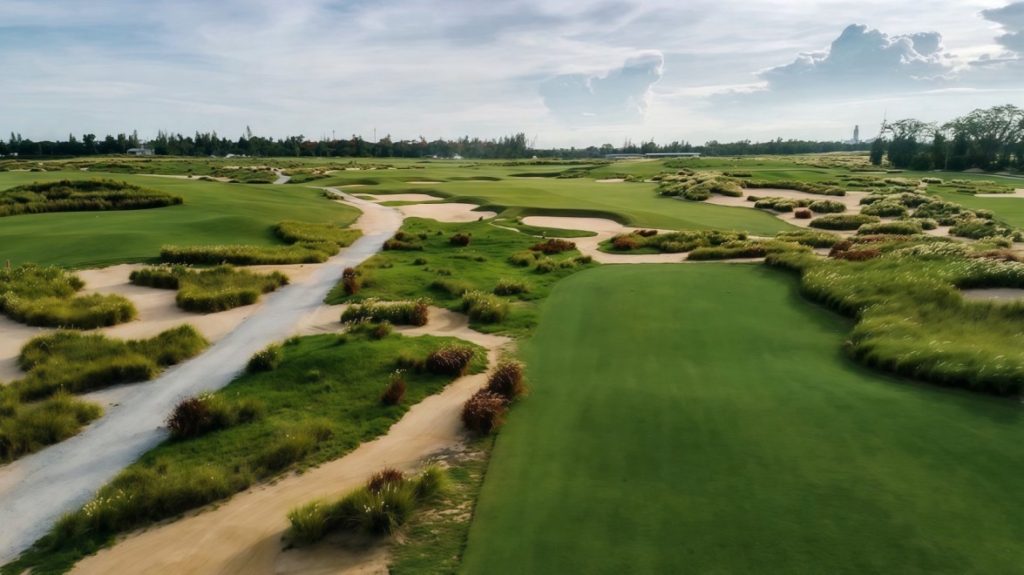
This land was originally a course called Kiarti Thanee Country Club. In other words, this was not construction from nothing but the remaking of an existing golf course. How do you give flat Thai ground links-like movement and shaping? That is where the skill in this design shows.
The decision to keep the greens firm and fast
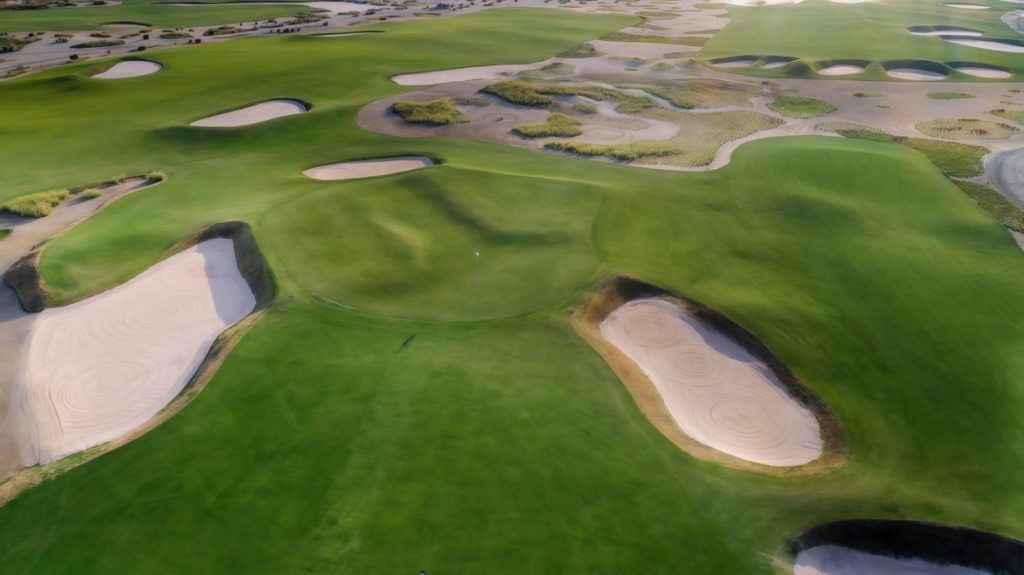
Alongside the template holes, the other thing that matters in describing Ballyshear is the condition of the greens. This course aims for firm and fast.
That feels different from the ordinary course in Japan or Thailand. At most courses the greens are designed on the assumption that the ball stops: you go straight at the pin with a high shot and hold it with spin.
On firm, fast greens that assumption collapses. You have to build the distance the ball will run after it lands into your calculation. Running it in from short of the green, using slope, using the ground outside the putting surface — you need the thinking of links golf.
Most first-time visitors have the experience of thinking they held the green and watching the ball trickle over the back. That is not a mistake; it is the difference in thinking that this course is asking for. Get a feel for it within two or three holes and the rest of the round becomes far more enjoyable.
Why it calls itself Links
The name carries Golf Links, but this is not seaside dune country. A true links means a course that formed naturally on sandy ground between the sea and the land inland. So why this name?
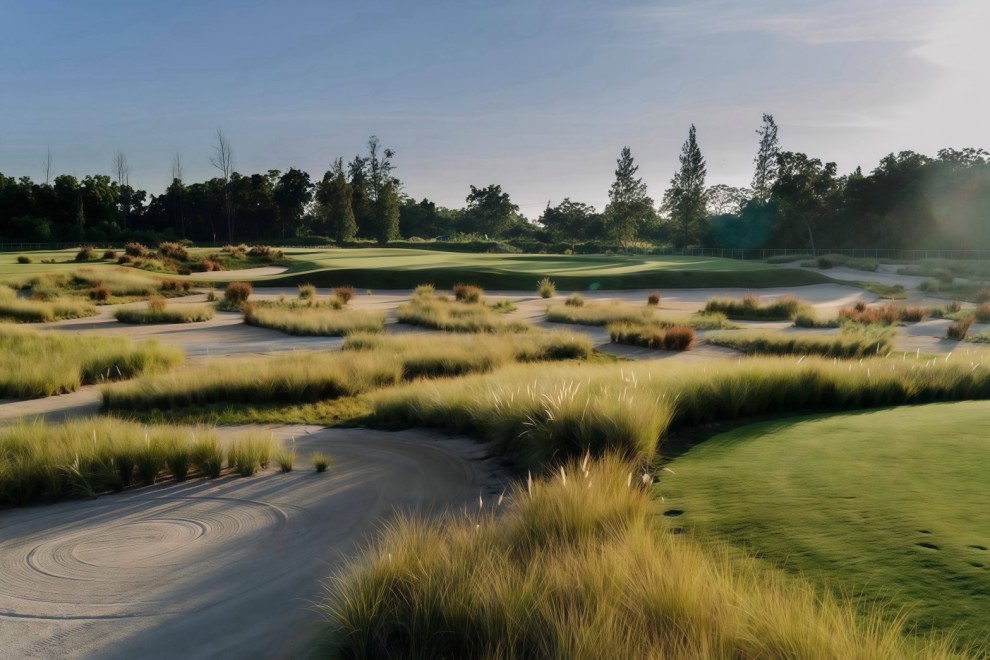
The reason lies in the style of golf. The essence of links golf is not the terrain but the idea of attacking along the ground. Instead of flying it and stopping it, you land it, run it, and use slope to get it close. Firm, fast greens and ground given movement are the conditions that make that style of play possible.
Lido itself, the model for this course, was built artificially on reclaimed marshland in the first place. Bringing the links style to a place with no natural dunes. What Macdonald and Raynor did on Long Island, Gil Hanse is attempting on flat ground in Thailand — seen that way, the name is not signage but a statement of intent.
Play the course and you notice that the movement in the ground bites harder than it looks. Land it slightly off your spot and the ball runs somewhere you did not expect. From the air game to the ground game. Whether you can switch your thinking is what decides your score for the day.
Location and access
Ballyshear is at Ban Rakat in the Bang Bo district of Samut Prakan. It sits east-south-east of central Bangkok, in the area along Bangna-Trad Road.
That stretch of Bangna-Trad Road is the axis along which Samut Prakan’s golf courses are concentrated. Subhapruek, Lakewood, Thana City, Green Valley and Siam Country Club Bangkok all line the same road. Being able to build a multi-course itinerary easily is a major advantage of this area.
For transport, use a company car or your own vehicle, or a ride-hailing service such as Grab, which is widely used in Bangkok. It is relatively close in the direction of Suvarnabhumi International Airport, and from Sukhumvit in the city centre the route uses the expressway and Bangna-Trad Road. Travel time varies with traffic, so allow extra time.
Please note that GoGolf does not operate or arrange transfers or shuttle services. As this is a course out on the suburban side, it is worth thinking about your ride home in advance.
How to think about scoring
Ballyshear is a course that asks you to think. Every one of the template holes is designed to force a choice on the player.
- Build every green shot around the run. They are firm and fast, so carry-and-stop alone will not fit.
- Attack from short. Miss long and you are left with a fast downhill putt or chip.
- On the Cape hole, judge by your own numbers. The more you take on the better, but only if you carry it.
- On the Biarritz, check where the swale is. Whether the pin is beyond it or short of it changes your target completely.
- Play the Redan from the right. It is designed to feed the ball with slope, so a direct shot at the pin will not hold.
- Play the 17th as a three-shot hole. 605 yards is not a distance to force in two.
- Ask your caddie. On template holes, knowing the intent changes the difficulty.
The typical way a score falls apart is attacking exactly as you would at your usual course: straight at the pin, stopping it with spin. By the time you realise the design does not allow that, you have given away several shots.
How the eighteen holes flow
Early on: the 3rd, Eden, poses the first question
For the first few holes, the priority is getting a feel for the speed and firmness of the greens. Then comes the 3rd, Eden. It is a par 3, but the slope of the green and the bunker short of it mean you cannot simply hit it. Whether you notice here that this course is different is the dividing line.
4th and 5th: Channel and Cape back to back
The 4th, Channel, involves water heavily. The 5th, Cape, is a hole where you decide for yourself how much of the corner to cut on the way to a green set on a headland.
These two holes form a stretch of consecutive attack-or-lay-up decisions. Succeed at the first and you will want to take on the second, and there are plenty of cases where that is exactly where the round comes apart. Judge each hole independently.
8th: the long green of the Biarritz
The Biarritz is characterised by a deep swale running through the middle of a very long green. On a day when the pin is cut beyond the swale, you need the carry to clear it. Land it short and you are left with an enormous putt across the swale. This is a hole where you cannot skip checking the pin position.
Late on: the 17th, Long, tests both stamina and judgement
The 17th, Long, is a 605-yard par 5. Putting that distance late in the round is a deliberate decision. How do you allocate three shots when fatigue has set in? Rather than forcing distance, building the hole so that you leave yourself a number you like is what works.
The skill of running it close
On a course with firm, fast greens, your options around the green change. The more you are used to lofting it with a lob wedge and stopping it, the more this difference will throw you.
Run it rather than lift it
On firm greens even a high shot bounces and runs once it lands. So aiming to stop it does not stop it as much as you expect. Given that, planning for run from the start and going in low from short of the green is easier to calculate.
Running one with an 8-iron or a pitching wedge, putting from off the green — whether you have those options clearly changes how often you get it close.
Make the slope your ally
Many of the template holes are designed on the assumption that you will use slope to get the ball close. The Redan is the archetype: the green is set on the diagonal and falls from right to left. Instead of going at the pin, land it on the high right side and let the slope carry it. That is the line of attack the architect intended.
Not avoiding slope but using it. Make that shift and the way you see the course changes.
Put the wind in your calculation
A course with links-style shaping has little to block the wind, so wind affects it more. A low ball fights it; a high ball gets moved. The windier the day, the more the running option pays.
Common mistakes, and how to avoid them
1. Going straight at the pin as usual
This is the most common mistake. On firm, fast greens, aiming straight at the flag and trying to stop a high ball means it lands, runs and goes through the back. Decide where on the green you want to land it, then choose the club. Keeping that order alone cuts down the big numbers.
2. Not checking the pin on the Biarritz
The 8th green is very long, with a deep swale running through the middle. Land it short when the pin is beyond the swale and you are left with an enormous putt across it. Check the pin from the tee and decide whether you are carrying the swale or stopping short of it before you play.
3. Getting greedy on the Cape
The Cape hole at the 5th is designed so that the more you take on, the shorter it gets. For exactly that reason you need to decide, using your own numbers, how much you can reliably carry. Judge it by feel and you will usually be generous with yourself.
4. Going for the 17th in two
A 605-yard par 5 is a three-shot hole. Late in the round with fatigue setting in, forcing distance produces mistakes. Decide your allocation in advance so that your third is a number you like, and you will hold together to the end.
5. Skipping putting practice
On this course the result changes depending on whether your body knows how fast the greens are. Spending ten minutes on the putting green before you start reliably cuts your three-putts over the opening holes.
How it differs from other Samut Prakan courses
The courses along Bangna-Trad Road have distinctly different characters. To place Ballyshear among them, here it is alongside the main courses in the same area bookable through GoGolf.
- Ballyshear Golf Links — 18 holes, par 71, over 7,000 yards. Gil Hanse, opened 2021. A tribute to the lost Lido, with template holes and firm, fast greens.
- Subhapruek Golf Club — 18 holes, par 72, about 6,837 yards. Pete & Perry Dye, opened 1993. The island green at the 16th and a closing stretch shaped by water.
- Thana City Country Club — 18 holes, par 72, about 6,966 yards. Greg Norman, opened 1993. Long, demanding par 3s and high-lipped bunkers.
- Lakewood Country Club — 27 holes, par 72, about 7,145 yards. Mike Poellot, opened 1992. The Lake, Wood and Rock nines can be combined in different ways.
- Siam Country Club Bangkok — 18 holes, par 72, about 7,250 yards. Toby Cobb. Zoysia fairways and large greens of up to 1,000 square metres.
What makes Ballyshear distinct within that group is that the course design itself is the subject. Not the beauty of the scenery or the luxury of the facilities: thinking about why this hole was built this way becomes the pleasure of the round.
The surroundings and making the most of a Bangkok stay
Samut Prakan is the province adjoining Bangkok to the south-east. The area along Bangna-Trad Road mixes industrial estates, housing and golf courses, and it wears the face of a place of work and industry rather than a tourist destination.
For accommodation, most people either stay on the city side, in Sukhumvit or similar, or use a hotel near Suvarnabhumi Airport. Staying near the airport has the advantage of a short journey the next morning.
Because the golf courses are concentrated in this one stretch, an itinerary such as three rounds over three days is easy to put together. Take in the architecture at Ballyshear, play water-lined Subhapruek the next day, then 27-hole Lakewood after that. You can experience completely different golf on consecutive days while keeping travel to a minimum.
Who this course suits
- Anyone interested in course architecture: places where you can walk Eden, Cape, Biarritz and Redan in a single day are not common anywhere in the world.
- Anyone who wants to try links-style golf: firm, fast greens demand the skill of running it close.
- Intermediate players and above: the precision of your judgement translates directly into the result, so the more you can think your way round, the more you will enjoy it.
- Anyone looking for a new course: opened in 2021, it is one of the most talked-about courses near Bangkok.
- Anyone looking for the centrepiece of a golf trip: if you are adding one special round to a stay, this is a strong candidate.
On the other hand, on a day when you just want to hit it straight and enjoy yourself, this may be a course that makes you work. That load, though, is precisely where its value lies.
Facilities and services
A modern clubhouse
GolfBangkok describes a modern clubhouse that stands in deliberate contrast to the classic links laid out in front of it, with comfortable locker rooms. The design thinking on the course reaches back to the 1910s; the building that receives you does not. The same piece also mentions plans to develop a hotel and practice facilities.
What the listings show
Golfsavers lists caddies, golf carts, practice facilities, golf lessons, club and shoe rental, night golf, a golf shop, on-site accommodation and spa and massage.
This is a private club, and what is actually available can change. If there is something you want to use, confirm it with the club or your booking channel when you reserve.
Booking a private club
Visitor slots are limited. Rather than fixing your dates and then hunting for a tee time, it works better to build the day around the slot you can get. Check what GoGolf holds on the app or website.
What to bring
You can turn up with nothing, but these things change the quality of the round.
- Sunscreen and a hat — on open shaping there are stretches with little shade.
- Non-metal spike shoes — the usual requirement at Thai courses.
- Time for putting practice — ten minutes before you start pays on firm, fast greens.
Best season and time of day
The dry months from roughly November to February are the most comfortable, and also the period when the greens are most easily held firm and fast. This is the season in which you can experience the design intent of this course most honestly.
In the hot season from March to May, daytime temperatures climb, so an early start is the realistic choice. The rainy season from June to October is mostly short afternoon storms passing through, and a morning round is less affected.
Note, though, that in the rainy season the greens can go soft, and the firm-and-fast character may fade. If you want to experience this course as it is meant to be, the dry season is worth choosing.
Pairing it with other Samut Prakan courses
Courses of very different character line Bangna-Trad Road. If you are playing several rounds during a stay, you can enjoy quite different golf while keeping travel time down.
- Subhapruek Golf Club — a Pete and Perry Dye design, where the island green and water take the lead.
- Lakewood Country Club — 27 holes, so the nines can be recombined each time.
- Thana City Country Club — a Greg Norman design, with long par 3s in the routing.
- Siam Country Club Bangkok — a newer course, defined by zoysia fairways and large greens.
Availability and green fees across the area are on the Samut Prakan golf booking page.
Summary
Put simply, there are three reasons to choose Ballyshear.
- The design — Gil Hanse’s tribute to the lost Lido, opened October 2021.
- The template holes — Eden, Channel, Cape, Biarritz, Redan, Long. A walk through the history of golf architecture in one round.
- The greens — firm and fast, demanding the links thinking of running it close.
Ballyshear Golf Links (Ban Rakat Club) is 18 holes, par 71, over 7,000 yards from the back tees. It was built on the site of the former Kiarti Thanee Country Club as two returning nines.
The value of this course is not whether you score well. It is that when you finish the round, the way you see golf has shifted slightly. Why is this bunker here? Why does this green fall this way? Courses you can walk while holding questions like that are not common.
Attack it as you usually would and it does not click; read the design intent and it suddenly becomes fascinating. If you are looking for one special round near Bangkok, this is the first course to come up. Check today’s tee times and green fees on the GoGolf app or website.
Frequently asked questions
Where is Ballyshear Golf Links?
Are Ban Rakat Club and Ballyshear the same place?
How many holes is it, and what is the par?
Who designed the course?
What is Lido?
What is a template hole?
How should I play the Biarritz?
Which are the signature holes?
Where does the difficulty lie?
Can a beginner play here?
What was the land before?
How should I build the 17th, Long?
What does two returning nines mean?
Which tee should I choose?
Do I need a caddie?
When is the best season to play?
How much are the green fees?
Is there a transfer service?
I hear the greens are fast. How should I deal with that?
The name says Golf Links. Is it a seaside course?
Is there anything worth doing before the round?
Are there other golf courses nearby?
More Golf Courses in Samut Prakan
Swipe to see more courses →