


Last updated: August 19, 2026
Green Valley Country Club is an 18-hole, par-72 course in the Bang Phli district of Samut Prakan. It was designed by Robert Trent Jones Jr. and opened in 1988. It measures about 7,028 yards from the back tees, 6,230 from the club tees and 5,544 from the front.
What defines the look of this course is its bunkers faced with railway sleepers. Separating sand from turf with timber is a classical technique that originates on the links courses of Britain, and it is a rare sight in Thailand. It leaves a strong visual impression and serves a practical purpose at the same time: it shows you exactly where the hazard begins.
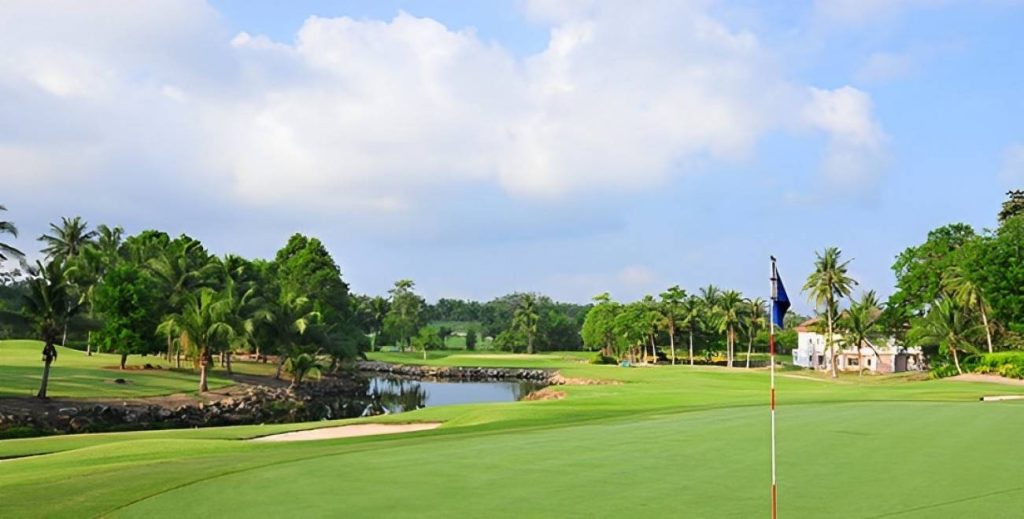
The other defining element is water. It comes into play on roughly two-thirds of the holes. The back nine in particular has more water and more open sky, so the character of the course shifts noticeably between the two halves.
The course rating from the back tees is 74.2. Against a par of 72, that number tells you this is a course with real substance. It is close to Suvarnabhumi International Airport and sits on Bangna-Trad Road, which makes it easy to reach. Check today’s tee times and rates on the GoGolf app or website.
Rates and booking
Green fees vary by day of the week, public holidays, season and timing. The rates shown on GoGolf reflect these in real time as closely as possible, so please check the GoGolf app or website for current pricing.
Price summary
Green fee + cart, per playerTHB3.350to4.250
| AM from | PM from | |
|---|---|---|
| Weekday | THB 3.350 | THB 3.350 |
| Weekend & holiday | THB 4.250 | THB 3.950 |
Price calendar
21 Oct – 17 Nov 2026 · THBWeekend & holiday rateNo tee timesM = million THB, lowest of each half-day
Book more easily with the GoGolf app


Course information
| Location | 92 Moo 3, Bangna-Trad Road, Bang Chalong, Bang Phli, Samut Prakan 10540 |
|---|---|
| Designer | Robert Trent Jones Jr. |
| Opened | 1988 |
| Holes | 18 holes, par 72 |
| Length | Back about 7,028 yards / Club about 6,230 yards / Front about 5,544 yards |
| Course rating (SSS) | Back 74.2 / Club 69.9 / Front 72.8 |
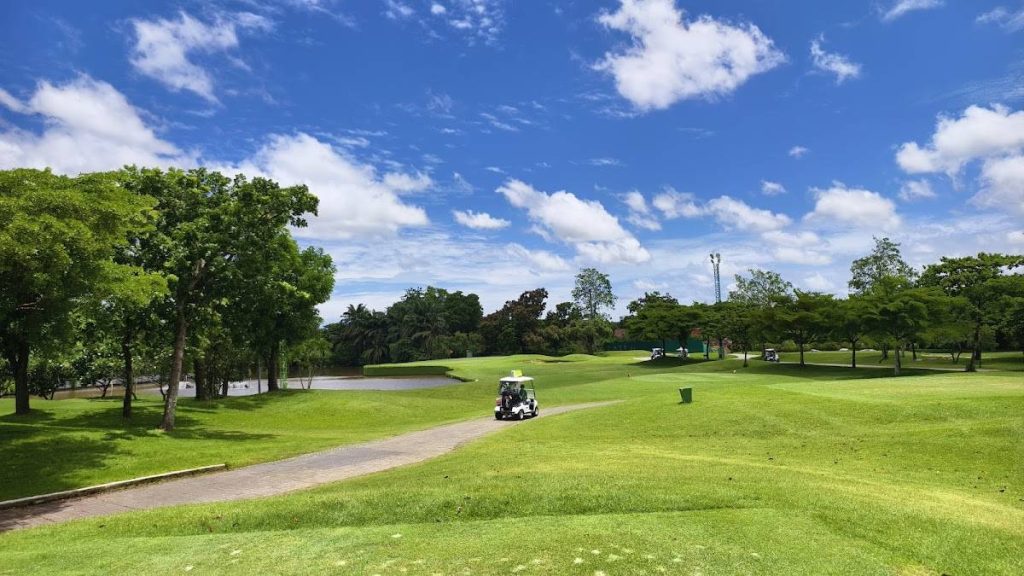
| Course type | Open parkland fringed with trees; gentle movement and easy walking |
| Defining features | Sleeper-faced bunkers. Water in play on roughly two-thirds of the holes. Palm avenues and traditional wooden shelters |
| Signature hole | The par-3 17th, where water is heavily in play |
| Practice | Practice facilities available |
| Caddies and carts | Caddies for all players. Carts available for hire |
| Spikes | Non-metal spikes only |
| Telephone | +66 81 350 9454 |
| Official site | greenvalleybangkok.com |
| Rates | Vary by day, season and tee time. Check current rates on the GoGolf app or website |
The design of the sleeper-faced bunkers
Anyone who has played Green Valley once remembers the bunkers faced with railway sleepers.
Normally the edge of a bunker is finished in turf. Here, on some holes, timber is stacked between the sand and the grass. This is the classical railway-sleeper treatment, which originates on the links courses of Britain.
More practical than it looks
The treatment does more than decorate. It makes the outline of the hazard clearly visible. A turf-edged bunker blurs at distance and you cannot be sure where the edge sits. With timber, you can see exactly where the sand starts — which means you can calculate the distance accurately.
Awkward once you are in
On the other hand, the difficulty rises sharply if you find one. Because the face is vertical, a ball resting against the timber leaves you unable to take a normal stance. There are situations where playing out sideways, or backwards, is the correct call.
In other words, these bunkers carry a clear message: you can see them, so avoid them. The information is given and the responsibility left with you — thinking that is characteristic of Robert Trent Jones Jr.
Two halves with different characters
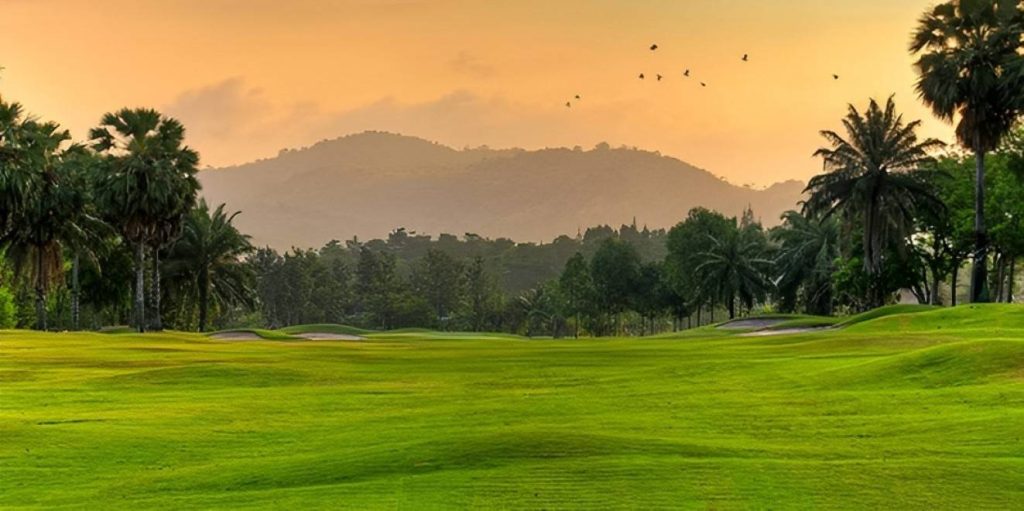
The eighteen holes at Green Valley have a different character on each nine.
The front nine: parkland sheltered by trees
On the front nine, palms and other trees frame the fairways and the atmosphere is that of settled parkland. The fairways are cleanly shaped, the movement is gentle and it walks easily. Establishing the speed and the general run of the greens over this stretch is your preparation for what follows.
The back nine: more water, more open sky
On the back nine the number of holes with water increases and the course opens out. With fewer trees to block it, the wind moves more freely and club selection gets harder.
And then the par-3 17th. With water heavily in play, it is a deliberate checkpoint placed late in the round. The better your score has been going, the more that one shot weighs on you.
Water in play on roughly two-thirds of the holes is a high proportion even around Bangkok. Build your round on the premise that this is a course about water, and your decisions stay consistent.
Large, rolling greens
The greens at Green Valley are large, and they roll.
A large surface means a higher chance of finding it. But it also means that where you finish changes the difficulty of the putt entirely.
Land on the opposite side from the flag and you are left with a long putt across the movement. Almost every three-putt on this course comes not from missing the green but from hitting it without having decided where on it to land.
The remedy is straightforward. Check the pin position and aim for the area nearest to it. And with your first putt, prioritise leaving the next one uphill rather than getting the pace exactly right. Those two things alone will reduce your putt count.
Location and access
Green Valley is in Bang Chalong, in the Bang Phli district of Samut Prakan. The address is 92 Moo 3, Bangna-Trad Road, Bang Chalong. It sits on Bangna-Trad Road — the axis along which the courses of Samut Prakan are concentrated.
That location has practical value. It lies in the direction of Suvarnabhumi International Airport, which makes it easy to fit into the spare hours of an arrival or departure day. Lakewood, Thana City and Siam Country Club Bangkok are on the same road, which also makes an itinerary of several courses easy to build.
For transport, use a company car or your own vehicle, or a ride-hailing service such as Grab, which is common in Bangkok. From the city centre the route uses the expressway and Bangna-Trad Road, and journey time varies with traffic. Weekday mornings and evenings congest easily, so leave with time in hand.
Please note that GoGolf does not arrange transfers or shuttles.
How to think about scoring
The key to putting a score together at Green Valley is whether you can treat the sleeper bunkers and the water clearly as things to avoid.
- Never find a sleeper bunker. Against the timber you cannot take a normal stance and may not get out in one.
- Ask your caddie the distance to the bunkers. The outlines are easy to see, so with a number the decision is simple.
- Keep the lay-up option on water holes. With water on roughly two-thirds of the holes, you make that call often.
- Aim at the part of the green nearest the pin. On large rolling greens, the far side means a long putt.
- Watch the wind on the back nine. With fewer trees and more open sky, it has more effect.
- Play the 17th with something in reserve. Water is heavily in play, and its position late in the round tells.
The course rating from the back tees is 74.2. More than two shots above a par of 72, that number says the back tees are genuinely demanding. The club tees are about 6,230 yards and the front tees about 5,544. Choosing a tee that fits you is the first move towards enjoying this course.
Common mistakes, and how to avoid them
1. Finding a sleeper bunker
Precisely because you can see them, it is easy to assume you will not reach them. But swing without checking the distance and one of them may be waiting exactly where your ball lands. Ask how far it is to the bunker before you choose a club. That single habit avoids a great deal of trouble.
2. Hitting large greens without a plan
Finding the surface is not enough. On a large green with movement in it, landing on the far side makes a three-putt a realistic prospect. Decide which part of the green you are aiming at before you swing. That is the shortest route to fewer putts.
3. Not changing clubs on the back nine
The wind the trees sheltered you from on the front nine hits you directly on the back. Choose clubs by the same feel as before and you may come up short on the water holes. Make a habit of checking the wind again on the 10th tee.
4. Attacking too much at the 17th
A par 3 with water heavily in play, placed late in the round. The architect put that checkpoint there deliberately. Aim at the centre of the green rather than the flag. Simply switching to a two-putt mindset prevents a late collapse.
What to bring
You can turn up with nothing, but the following change the quality of the round.
- Sunscreen and a hat — the back nine opens out with less to shade you.
- Non-metal spiked shoes — metal spikes are not permitted.
- Spare balls — water is in play on roughly two-thirds of the holes, so bring more than you think.
The best season and time of day
The dry season from about November to February is the most comfortable: humidity drops, and mornings and evenings can feel genuinely cool.
In the hot season from March to May the daytime temperature climbs, so an early start keeps the toll down. Because the open stretch comes on the back nine, avoiding the strongest sun matters a good deal here.
The rainy season from June to October is mostly a short afternoon squall passing through. A morning round is less affected, and tee times are comparatively easy to get.
Who this course suits
- Anyone who appreciates design: one of the few courses in Thailand where you can experience classical sleeper-faced bunkering.
- Anyone testing their water management: with water on roughly two-thirds of the holes, the decisions come thick and fast.
- Anyone staying near the airport: it lies towards Suvarnabhumi, so it fits an arrival or departure day.
- Better players: a course rating of 74.2 from the back tees gives you something to get your teeth into.
- Improving players: the front tees are about 5,544 yards, so choosing the right tee makes it thoroughly enjoyable.
- Anyone planning several rounds: on Bangna-Trad Road, it combines easily with neighbouring courses.
On the other hand, if you prefer to keep well clear of water, the number of decisions may feel like a lot. In that case move up a tee and plan to lay up; you can play it that way without losing what makes the course good.
Combining it with other courses in Samut Prakan
Courses of quite different character line Bangna-Trad Road. If you are playing several rounds during your stay, you can enjoy different types of golf while keeping the travel down.
- Lakewood Country Club — 27 holes, with Lake, Wood and Rock combined for your eighteen.
- Thana City Country Club — a Greg Norman design, with a set of long and demanding par 3s.
- Subhapruek Golf Club — designed by Pete Dye and his son, with an island green waiting.
- Muang Kaew Golf Course — water concentrated on the front nine, with striking eucalyptus avenues.
Availability and rates for the whole area are on the Samut Prakan golf booking page.
In summary
The case for Green Valley comes down to three things.
- The design — bunkers faced with railway sleepers. A classical technique, rare in Thailand, that works both visually and practically.
- The water — in play on roughly two-thirds of the holes, and weighted towards the back nine. A continuous run of decisions.
- The location — on Bangna-Trad Road, in the direction of Suvarnabhumi International Airport.
Green Valley Country Club is a Robert Trent Jones Jr. design, opened in 1988: 18 holes, par 72. About 7,028 yards from the back tees, with a course rating of 74.2. Parkland sheltered by trees on the front nine, water and open sky on the back — the character shifts within a single round.
Check today’s tee times and rates on the GoGolf app or website.
Frequently asked questions
Where is Green Valley Country Club?
How many holes is it, and what is the par?
Who designed the course?
What are sleeper-faced bunkers?
How much water is in play?
Which is the signature hole?
Where is the difficulty?
Can a beginner play here?
Is there a difference between the two nines?
Is there a driving range?
What about caddies and carts?
Is there a spike rule?
What is the best season and time of day?
How much does it cost?
Is there a transfer service?
More Golf Courses in Samut Prakan
Swipe to see more courses →