


Last updated: August 19, 2026
Windsor Park and Golf Club is a 36-hole club in the Nong Chok district of eastern Bangkok. It was designed by Ron Fream and opened in 1994. The property is laid out as four nines — Lagoon (A), Palm (B), Garden (C) and Lakeside (D) — which are combined to make up your eighteen.
A+B plays to par 72 at about 6,904 yards from the back tees, 5,850 from the club tees and 5,266 from the front. C+D is also par 72, at about 6,911 yards from the back, 5,799 from the club tees and 5,164 from the front. The lengths are nearly identical. The character could not be more different.
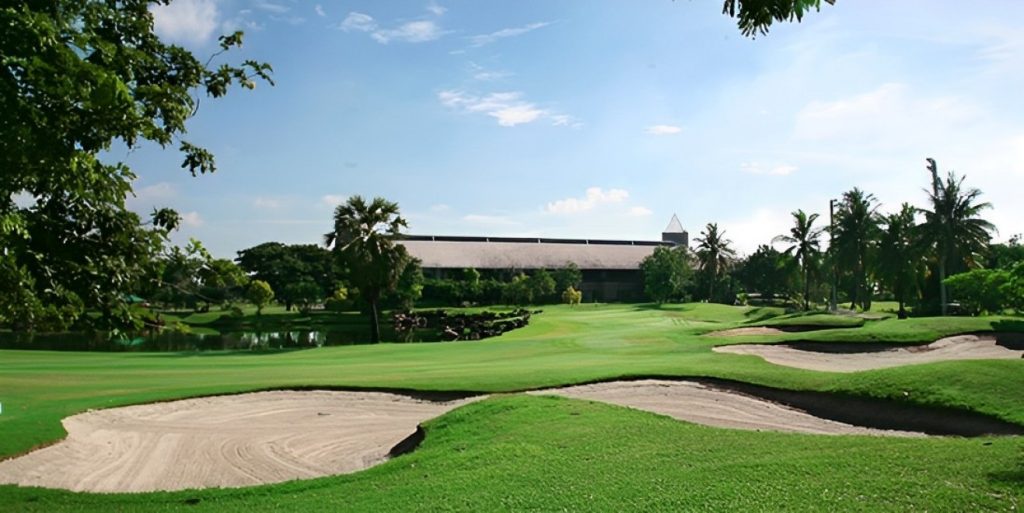
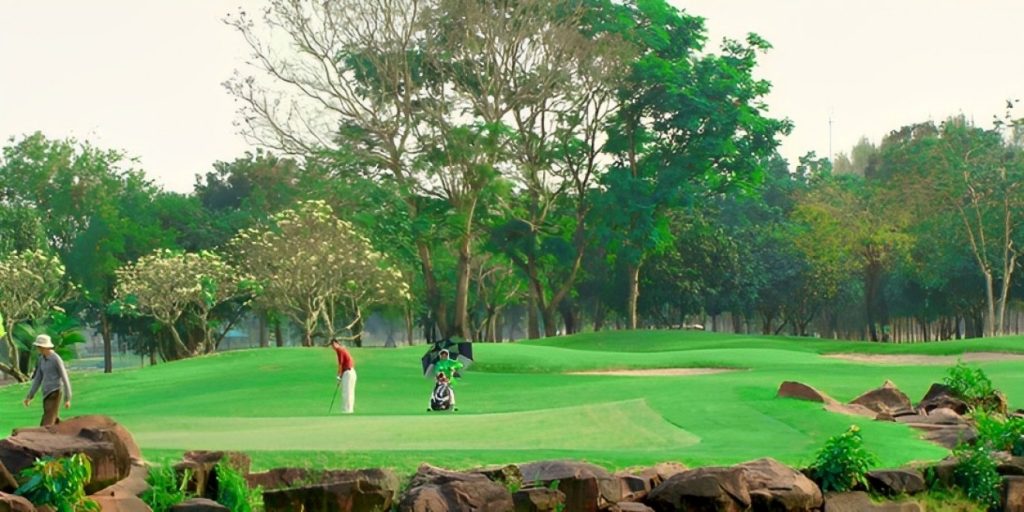
A, B and C are settled parkland framed by trees: softly shaped fairways, striking bunkering and ponds edged with rock. D, by contrast, is open and undulating with young trees — a type you rarely find around Bangkok. Two different kinds of golf live inside the same club.
The former name was Panya Park. The great appeal of the place is being able to choose which combination you play today, on the scale of thirty-six holes. Check today’s tee times and rates on the GoGolf app or website.
Rates and booking
Green fees vary by day of the week, public holidays, season and timing. The rates shown on GoGolf reflect these in real time as closely as possible, so please check the GoGolf app or website for current pricing.
Price summary
Green fee + cart, per playerTHB2.250to2.900
| AM from | PM from | |
|---|---|---|
| Weekday | THB 2.250 | THB 2.250 |
| Weekend & holiday | THB 2.900 | THB 2.900 |
Price calendar
5 Oct – 1 Nov 2026 · THBWeekend & holiday rateNo tee timesM = million THB, lowest of each half-day
Book more easily with the GoGolf app


Course information
| Location | 46 Moo 8, Soi Suwinthawong 15, Khok Taet, Nong Chok, Bangkok 10530 (Nong Chok district, eastern Bangkok) |
|---|---|
| Designer | Ron Fream |
| Opened | 1994 (formerly Panya Park) |
| Holes | 36 holes (four nines: Lagoon=A, Palm=B, Garden=C, Lakeside=D) |
| Length (A+B) | Back about 6,904 yards / Club about 5,850 yards / Front about 5,266 yards (par 72) |
| Length (C+D) | Back about 6,911 yards / Club about 5,799 yards / Front about 5,164 yards (par 72) |
| Course type | Open parkland fringed with trees. A to C walk easily; D has real undulation |
| Signature holes | The par-3 3rd on Palm (B), with bunkers lined up from tee to green / the par-5 9th on Garden (C) / the run of the 2nd, 3rd and 4th on Lakeside (D), where water is in play |
| Clubhouse | Thai, Japanese, Chinese and Western food |
| Practice | Practice facilities available |
| Caddies and carts | Caddies for all players. Golf carts available |
| Spikes | Non-metal spikes only |
| Telephone | +66 2 989 4200 |
| Rates | Vary by day, season and tee time. Check current rates on the GoGolf app or website |
What the scale of thirty-six holes actually means
The defining feature of Windsor Park is that it has four nines: Lagoon (A), Palm (B), Garden (C) and Lakeside (D). In principle, combining them gives you several possible eighteens.
In practice, two combinations form the basis of play: A+B and C+D. Both measure around 6,900 yards from the back tees, but the impression they leave is entirely different. You arrive at the same club and feel as though you have gone to another course. That is an experience only a thirty-six-hole property can offer.
The arrangement pays off on repeat visits. A+B the first time, C+D the second. For anyone staying in Bangkok, or living here and playing regularly, being able to play something different from last time is worth a great deal.
It suits groups and competitions too. Even with a large field, starts can be spread out and waiting kept down. The scale works as operational flexibility as much as anything else.
Ron Fream’s design, and the former name Panya Park
The architect was Ron Fream, who has built courses around the world. Around Bangkok, Panya Indra Golf Club is also his. In fact Windsor Park was formerly called Panya Park, and the names of the nines — Lagoon, Palm, Garden — share something with that course too.
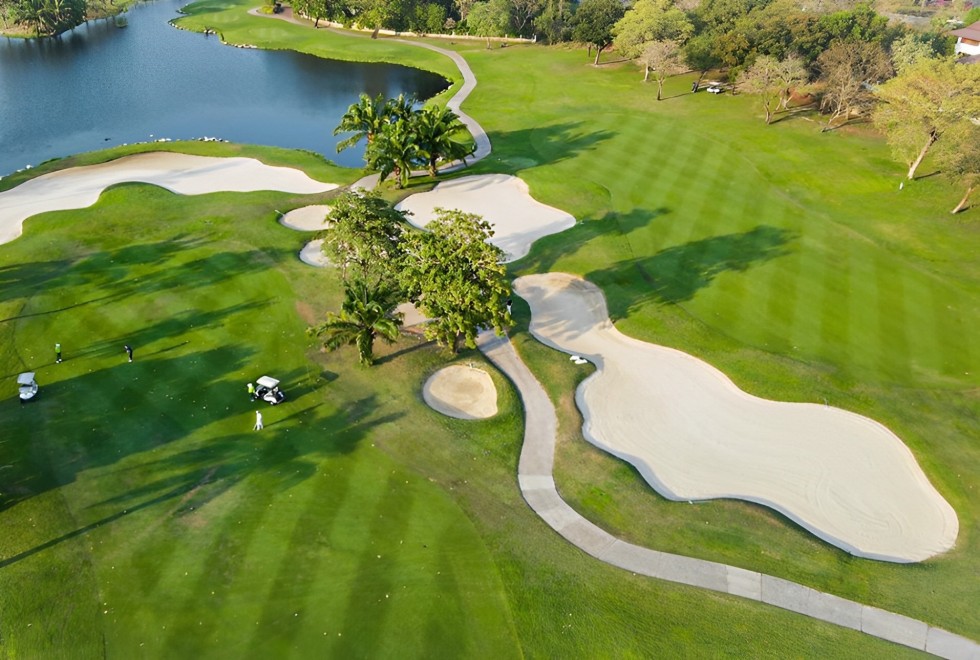
Fream’s work builds strategy from detail rather than from dramatic earth-moving. At Windsor Park the fairways are shaped in soft waves, the bunkers are placed in shapes that catch the eye, and the ponds are edged with rock.
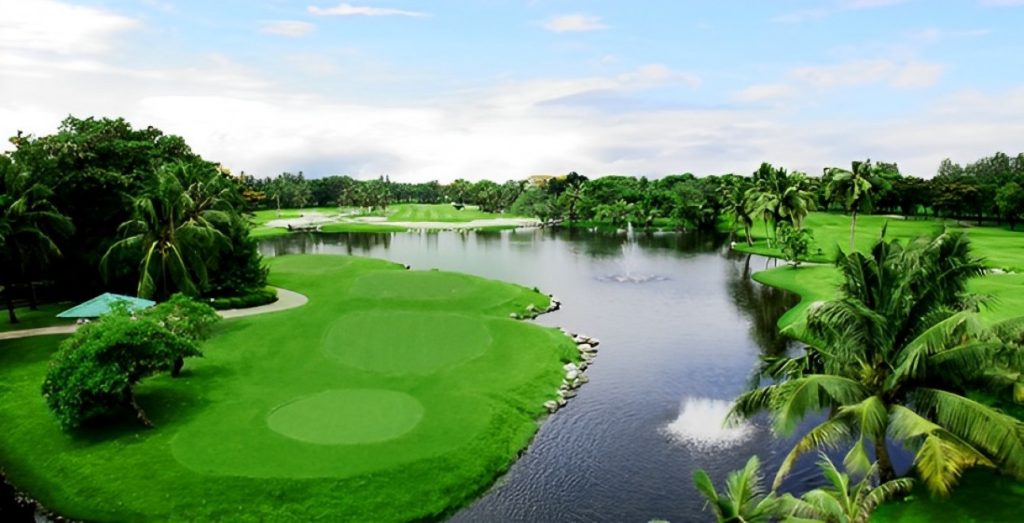
That rock edging is not merely decorative. Because the water’s edge is clearly visible, you can judge the distance to it, and the tension is sharpened at the same time. Rather than blurring the hazard, the danger is shown plainly. That is characteristic of Fream’s thinking.
More than thirty years have passed since it opened in 1994, and the trees on A, B and C have matured. A settled quality that was not there at construction now defines the landscape.
The character of the four nines
A (Lagoon) and B (Palm): finished parkland
A and B are the most classical nines at Windsor Park. Trees frame the fairways and you play through a landscape lined with palms. The movement is gentle and walks easily, with bunkers and water in good balance.
Combined, they play to par 72 at about 6,904 yards from the back tees. An island green, doglegs, bunkers guarding the greens, and changes in elevation — everything you would expect of a parkland course is present.
B (Palm), the 3rd: a wall of sand
The par-3 3rd on B is one of the most memorable holes at the club. What stands out is the sheer number of bunkers lined up between the tee and the green. You do not often see that many gathered on a single hole.
The visual intimidation is considerable, but on a par 3 all that is really required is one accurate shot. Do not count the bunkers; look only at the green. It is a hole where your state of mind decides the result.
C (Garden): the same settled quality as A and B
C shares the character of A and B: parkland framed by trees, with softly shaped fairways, striking bunkering and rock-edged ponds.
The most highly regarded hole is the par-5 9th, balanced in length, shaping and the trade between risk and reward. It is one of the holes that represents this course.
D (Lakeside): an openness rare around Bangkok
D is nothing like the other three. It is open and undulating, and the trees are still young. The palms that have been planted need time to mature, so little blocks the view and you can often see across the whole course.
You do not find this type of layout often around Bangkok. Because of the undulation, walking it involves more climbing and descending than A to C. And on the early holes a large lake comes into play.
The opening three holes on D
What makes Lakeside (D) interesting is concentrated at the start: the 2nd, 3rd and 4th form a run of three holes built around water.
The 2nd: a decision on a short par 4
A short par 4, with water left and out of bounds right. Take a driver simply because the hole is short, and trouble waits on both sides. Lay up and put the ball safely on the fairway, or get close in one? A clear decision is demanded of you right after you start.
The 3rd: a par 5 around the lake
The par-5 3rd is laid out to wrap around the water. Cut the corner and you gain distance, but you also move closer to the lake. Go safely round the outside and you leave more to the green. Risk and reward are set out plainly — a par 5 that behaves like a par 5 should.
The 4th: a long par 3 over water
The 4th is a long par 3 played over water to a green heavily guarded by bunkers. Because of the length, choosing a club that will certainly carry is essential. After the judgement demanded at the 2nd and 3rd, you are now asked for pure distance and precision. Your score after these three holes decides your impression of D.
Location and access
Windsor Park sits on Suwinthawong Road in the Nong Chok district of eastern Bangkok. The address is 46 Moo 8, Soi Suwinthawong 15, Khok Taet, Nong Chok, Bangkok 10530 — about 35 kilometres north-east of central Bangkok.
The route from the city centre
From Sukhumvit the usual route is as follows. Take the Ram Inthra tollway to its end, exit right onto Route 304, head towards Minburi and cross the junction with the eastern outer ring road (Route 9). Stay on Route 304 through Minburi and the road becomes Suwinthawong Road. From there it is about 7 kilometres; the entrance is on the left just past the 44-kilometre marker.
For transport, use a company car or your own vehicle, or a ride-hailing service such as Grab, which is common in Bangkok. Journey time varies a great deal with traffic. Being a course on the outskirts, it is worth arranging the trip home in advance too.
Please note that GoGolf does not arrange transfers or shuttles.
The Pine Golf Club and Phoenix Gold Golf Bangkok are also in eastern Bangkok. Because the area has a concentration of courses, building an itinerary around several of them is straightforward.
Which combination to choose
Having thirty-six holes also means having to choose. Here is how to think about it on a first visit, according to what you want.
For settled parkland: A+B
Mature trees, a good balance of bunkers and water, and the wall of sand at the 3rd on B as the set piece. If what you want is the satisfaction of having played a parkland course in Bangkok, this is the straightforward choice. It walks easily and suits improving players.
For variety: C+D
From the settled C to the open, undulating D. The scenery and the feel switch between the front nine and the back. The run of water holes early on D is the highlight of the day. Bear in mind, though, that D climbs and descends, so consider your energy.
If you can play twice: both
If you can fit two rounds into your stay, A+B once and C+D once is the most luxurious use of the place. Same clubhouse, same caddie arrangements, and two entirely different rounds of golf on consecutive days.
How to think about scoring
What characterises Windsor Park is that you have to change your approach depending on the nine. What matters on A to C is not what matters on D.
- On A to C, be aware of the tree line. A ball that curves into the trees forces you to punch out sideways.
- On D, check the wind. It is open with little to block it, so the wind has more effect.
- The rock-edged ponds make distance easy to judge. Because the water’s edge is clear, you can calculate the carry.
- At the 3rd on B, do not look at the bunkers. Rather than being overwhelmed by the number, look only at the green.
- Keep the lay-up option at the 2nd on D. Water left, out of bounds right; the shorter the par 4, the more carefully you build it.
- Choose by carry distance at the 4th on D. On a long par 3 over water, getting there is the first priority.
- Ask your caddie about the day’s routing. What you need to know changes with which nines you play.
The back tees are around 6,900 yards, but the club tees drop to about 5,800. The range of tees is wide, so the design lets you enjoy it at your own level.
Common mistakes, and how to avoid them
1. Starting without checking which nines you are playing
At a thirty-six-hole club the day’s routing can differ from what you assumed when booking. Arriving expecting A+B and playing C+D leaves your preparation and your strategy misaligned. D in particular is very different in character, so check with reception or your caddie before you start.
2. Letting the bunkers take your eye at the 3rd on B
The bunkers lined up from tee to green are visually oppressive. But it is a par 3, and all you actually need is to match the distance with one shot. The moment you start counting bunkers, your attention has left the green. Pick the club, then look only at the green and swing.
3. Not allowing for the wind on D
D has young trees and little to block the view. That is open as a landscape, but it also means the wind blows straight through. Choose clubs as though you were on A to C and you will come up short, or go long, especially on the holes played over water.
4. Being drawn in by the shortness of the 2nd on D
A short par 4 invites you to try to get close in one. But water sits left and out of bounds right: there is no bail-out on either side. Laying up to a distance you are comfortable with produces the steadier score.
5. Misjudging your energy
A to C walk easily, but D has climbs and descents. Playing C+D means the second half takes more out of you. Not pushing too hard early, and taking water and rest regularly, protects your score at the finish.
Building the shape of your eighteen
Playing A+B
The layout runs through settled woodland, which makes a rhythm easy to establish. What to watch is the tree line: a ball that curves into the trees costs you a shot punching out sideways. If your natural shape curves a lot off the tee, not insisting on driver will keep your average over eighteen holes steadier.
The par-3 3rd on B is the highlight of this combination. Having your score in order by then means you can stand on that tee composed.
Playing C+D
The front nine on C plays much as A and B do. The rock-edged ponds show the water’s edge clearly, which helps you calculate the carry. Make a score at the par-5 9th and you head into the back nine with some room to breathe.
Then, the moment you step onto D, the landscape changes. It is open and undulating, and water runs through the 2nd, 3rd and 4th in succession. How you get through those three holes decides the day’s score. Do not force it; prioritise simply moving the ball forward.
Thinking about the finish
In either combination, fatigue and heat dull your judgement late in the round. With three holes left, do not try anything new. Repeat the club and the line that have been working.
Facilities and service
Clubhouse and food
The clubhouse covers a wide menu: Thai, Japanese, Chinese and Western food. Having a Japanese option after a round is a practical reassurance for Japanese golfers, and for a group it makes it easy to suit everyone’s taste.
Practice
There are practice facilities for loosening up before the round. With several holes played over water, confirming your carry distance before you start makes the day’s decisions much easier.
Caddies and carts
As is customary in Thailand, every player is accompanied by a caddie. On a thirty-six-hole property, a caddie who knows that day’s routing is especially valuable. Golf carts are also available.
The spike rule
Non-metal spikes only. Check the soles of the shoes you plan to bring.
The surrounding area and a stay in Bangkok
The Nong Chok area is within Bangkok yet spread with canals and farmland. It looks nothing like the high-rise centre, and the mood of the trip changes on the drive out to the course. Going a little out of your way for the golf gives you another side of Bangkok.
Most visitors stay centrally — Sukhumvit or Silom — and travel out to play, because hotels, restaurants and massage shops are concentrated there, which makes the non-golf hours easier to fill. Heading out by ride-hailing app in the morning and returning to the centre to eat is a realistic shape for the day.
Because eastern Bangkok has a cluster of courses, three rounds over three days is easy to arrange: two different combinations at Windsor Park, plus one neighbouring course. You get variety without long journeys between rounds.
Bangkok is one of the few cities where golf and city sightseeing fit comfortably into the same itinerary. A round in the morning, temples or markets in the afternoon and dinner in the evening is an entirely workable day.
How to enjoy a Ron Fream design
Play several courses by the same architect and their thinking starts to show. Bangkok has a second Fream design in Panya Indra Golf Club, and playing both reveals a shared grammar.
The decision is settled on the greens
Fream’s designs are not the kind that eliminate you with one tee shot. The fairways are not desperately narrow and a slight curve is rarely fatal. Instead the questions accumulate on and around the greens: where to land the approach, how to read the line of the putt. That accumulation becomes your score.
The water’s edge is shown plainly
Rock-edged ponds are a treatment often seen in Fream’s work. Because you can see exactly where the water starts, you can calculate the distance yourself. The information is given rather than concealed, and the responsibility for the decision is left with you. It is a fair design philosophy.
Different faces on the same ground
The difference between A to C and D shows that this architect deliberately varied the character within a single property: settled parkland on one side, an open undulating layout on the other. It is a contrast that only the scale of thirty-six holes made possible.
What to bring
You can turn up with nothing, but the following change the quality of the round.
- Sunscreen and a hat — D in particular offers little shade, so they are essential.
- Non-metal spiked shoes — metal spikes are not permitted.
- Spare balls — water is in play on several holes, so bring more than you think.
The best season and time of day
The dry season from about November to February is the most comfortable: humidity drops, and mornings and evenings can feel genuinely cool.
In the hot season from March to May the daytime temperature climbs, so an early start keeps the toll down. D in particular has little shade, which makes the choice of tee time especially important in this period.
The rainy season from June to October is mostly a short afternoon squall passing through. A morning round is less affected, and tee times are comparatively easy to get.
Who this course suits
- Anyone who wants to come back repeatedly: the four nines combine into a different round each visit.
- Groups and competitions: starts can be spread across 36 holes, and the clubhouse menu covers everyone.
- Improving players: about 5,800 yards from the club tees, with a wide range of tees to choose from.
- Anyone who enjoys a change of scene: settled A to C and open D — two faces at one club.
- Anyone who wants Japanese food: having it available in the clubhouse is practical for a long stay.
- Anyone staying in eastern Bangkok: other courses nearby make an itinerary easy to build.
On the other hand, at about 35 kilometres from the centre it does not suit anyone who needs to get out and back quickly. In that case a course chosen for access, such as The Royal Golf and Country Club near Suvarnabhumi Airport, is the better fit.
How it differs from other courses around Bangkok
The courses within Bangkok have distinctly different characters. To place Windsor Park among them, it helps to set it beside the other courses in the area bookable through GoGolf.
What is distinctive here is being able to choose between thirty-six holes of differing character within a single facility. The open, undulating layout of D in particular is not something you find often around Bangkok.
Combining it with other courses around Bangkok
Eastern Bangkok is where the courses cluster. If you are playing several rounds during your stay, pairing this with neighbouring courses keeps the travel down.
- The Pine Golf Club — in the same eastern Bangkok, with a 27-room lodge for stay-and-play.
- Phoenix Gold Golf Bangkok — also 36 holes, designed by Robert Trent Jones Jr.
- Panya Indra Golf Club — another Ron Fream design, with 27 holes and night golf.
- Navatanee Golf Course — host of the 1975 World Cup and a course with real history.
Availability and rates for the whole area are on the Bangkok golf booking page.
In summary
The case for Windsor Park comes down to three things.
- Thirty-six holes — the four nines of Lagoon, Palm, Garden and Lakeside, recombined as often as you like.
- Two faces — settled, mature A to C and open, undulating D. Different golf at the same club.
- The design — Ron Fream’s shaping in the detail, with rock-edged ponds and striking bunkering creating the strategy.
Windsor Park and Golf Club opened in 1994 and was formerly Panya Park. A+B is about 6,904 yards from the back tees and C+D about 6,911, both par 72. The bunkering at the 3rd on B, the par-5 9th on C and the run of water holes early on D are the things to see.
From the club tees it drops to around 5,800 yards, so you can play it comfortably at your own level. For anyone who finds playing the same course over and over tiring, this is a club worth choosing for its scale alone. Check today’s tee times and rates on the GoGolf app or website.
Frequently asked questions
Where is Windsor Park and Golf Club?
How do I get there?
How many holes are there?
What is the length and par?
Who designed it, and when did it open?
What is the difference between A to C and D?
Which are the signature holes?
Can a beginner play here?
Which combination should I choose?
Is there a driving range?
Can I eat at the clubhouse?
What about caddies and carts?
Is there a spike rule?
Can I choose which nines to play on the day?
What is the best season and time of day?
Which tee should I play?
Is there an official website?
How much does it cost?
Is there a transfer service?
What should I bring?
How does it compare with other Bangkok courses?
Can it host a competition or a group?
More Golf Courses in Bangkok
Swipe to see more courses →