


Last updated: August 19, 2026
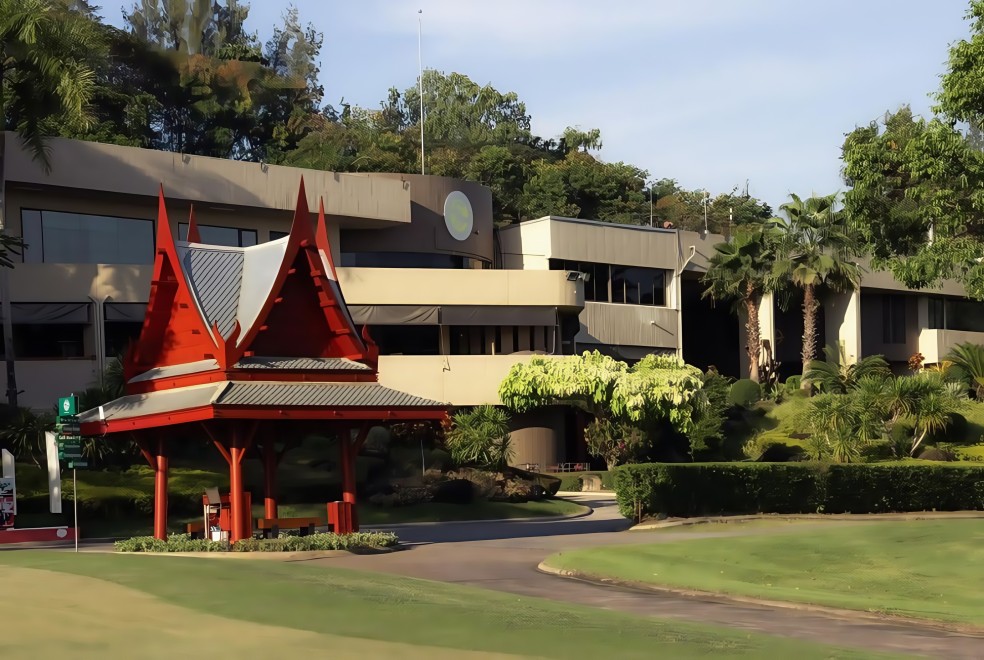
Siam Country Club Pattaya Old Course is an 18-hole, par-72 course in Pong, Bang Lamung, Chonburi. It measures about 7,162 yards, with a course rating of 74.1 and a slope rating of 137.
The value of this course lies in the fact that it is the history of Thai golf itself. It was designed by the Japanese architect Ichisuke Izumi and opened in 1970. The club describes it as Thailand’s first privately owned course (the official site gives 1971; external sources give 1970).
Between 2006 and 2007 it underwent a full renovation by Lee Schmidt and Brian Curley of Schmidt-Curley Design. The original routing was kept, while curved fairways, new lakes, steep-lipped bunkers and relocated greens brought it up to international tournament standard.
Since reopening it has hosted the Honda LPGA Thailand a number of times, and from 2010 it has been a stop on the US LPGA Tour. For today’s tee times and green fees, check the GoGolf app or website.
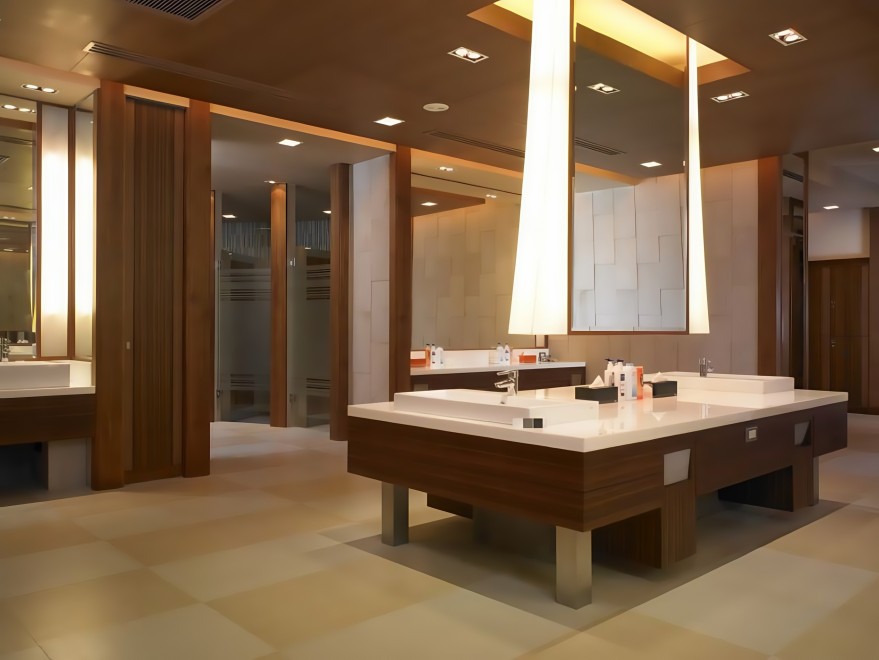
Green fees and booking
Green fees vary by day of the week, public holidays, season and timing. The rates shown on GoGolf reflect these in real time as closely as possible, so please check the GoGolf app or website for current pricing.
Price summary
Green fee + cart, per playerTHB5.850to7.350
| AM from | PM from | |
|---|---|---|
| Weekday | THB 5.850 | THB 5.850 |
| Weekend & holiday | THB 7.350 | THB 7.350 |
Price calendar
11 Oct – 4 Nov 2026 · THBWeekend & holiday rateNo tee timesM = million THB, lowest of each half-day
Book more easily with the GoGolf app


Course facts
| Address | 50 Village No. 9, Phonprapa Road, Pong, Bang Lamung, Chonburi 20150 |
|---|---|
| Original designer | Ichisuke Izumi |
| Renovation architects | Lee Schmidt / Brian Curley (Schmidt-Curley Design) |
| Opened | 1970 (the official site gives 1971) |
| Renovation | Fully renovated 2006-2007; reopened in 2007 |
| Holes | 18 holes, par 72 |
| Length | About 7,162 yards |
| Course rating | 74.1 / slope rating 137 |
| Course type | Classic tree-lined parkland |
| Trees | Mature tamarind and acacia |
| Standing | Thailand’s first privately owned course. Described as “the grand dame of Thai golf” |
| Tournaments | Honda LPGA Thailand (several times). A US LPGA Tour venue since 2010 |
| The 18th | A sweeping dogleg par 5 finishing in front of the clubhouse terrace |
| Practice | Putting green, chipping area, natural-grass driving range |
| Clubhouse | Lockers, showers, drying facilities. A 150-seat restaurant and a pro shop |
| Caddies and carts | Caddies compulsory for all players; carts compulsory and driven only by club caddies |
| Setting | Hill country a few kilometres inland from central Pattaya |
| Phone | +66 38 909 700 |
| Official site | siamcountryclub.com |
| Green fees | Vary by day, season and tee time. Check the GoGolf app or website for current rates |
The course where Thai golf begins
When you talk about the Old Course, the first thing to grasp is neither the design nor the length. It is the fact that this course stands at the starting point of golf in Thailand.
1970: Thailand’s first privately owned course
It opened in 1970, designed by the Japanese architect Ichisuke Izumi. The club describes it as Thailand’s first privately owned course.
On the opening year, the official site gives 1971 while external sources such as Golfasian give 1970. Both are noted here.
“The grand dame of Thai golf”
The official site calls this course the grand dame of Thai golf.
A course in continuous use for more than half a century has a depth no new build can manufacture: mature trees, well-worn paths, and terrain shaped by countless rounds.
A round for seeing the history
For anyone who has played Thai golf many times, the Old Course becomes a reference point.
What the other courses are aiming at, and what they are offering as new — the comparison starts here.
What the 2007 renovation changed
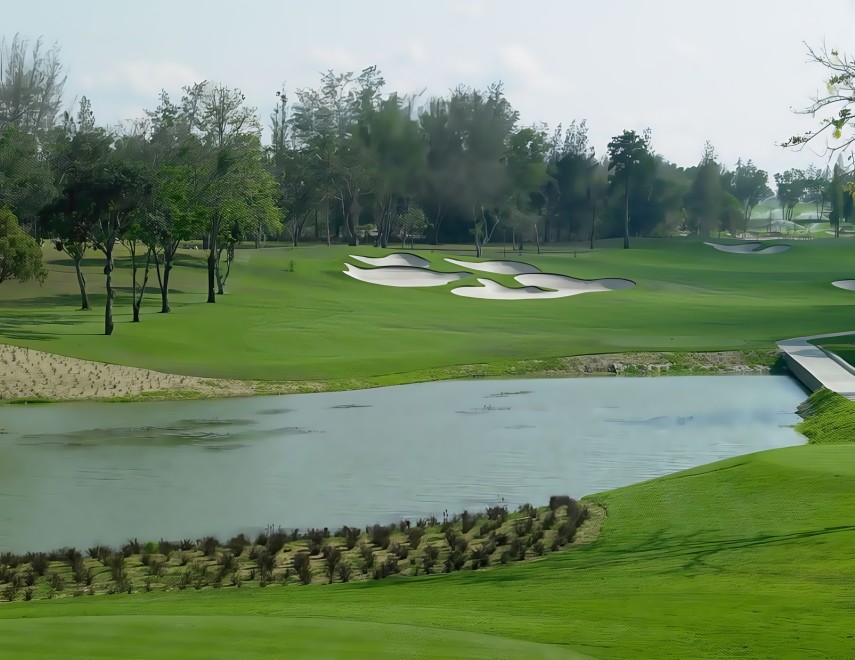
The 1970 design was not simply left in place. Between 2006 and 2007 the course was rebuilt in full.
Modernisation by Schmidt-Curley
The renovation was carried out by the Americans Lee Schmidt and Brian Curley of Schmidt-Curley Design.
The same team also built the neighbouring Plantation and Rolling Hills courses. Siam Country Club as it stands today is unified by these two architects’ thinking.
What was kept and what was changed
The key point of the renovation is that the original routing was retained. The order of the holes and the broad flow are as they were in 1970. On top of that, the following were modernised.
- Curved fairways — bend added to straight lines, narrowing where you can aim
- New lakes — water introduced as a strategic element
- Steep-lipped bunkers — reshaped so escaping takes real technique
- Relocated greens — position and shape rebuilt to tournament standard
In other words, a classic skeleton with modern detail. That is what the Old Course is today.
Tournament standard as the benchmark
A course rating of 74.1 and a slope rating of 137. These are not typical resort-course numbers.
The figures make clear that the renovation was not about tidying the appearance but about raising the course to a level fit for international competition.
The course the LPGA plays
Since reopening in 2007, the Old Course has been a venue for international competition.
The Honda LPGA Thailand
According to the official site, this course has hosted the Honda LPGA Thailand a number of times. It has been a US LPGA Tour venue since 2010.
You get to play the same eighteen holes the best players in the world have actually competed on. That is one of the strongest reasons to choose this course.
Walking the holes you saw on television
Walking the view you watched on a broadcast, and hitting it with your own clubs. That experience stays with you longer than the score does.
The 18th in particular. The sweeping dogleg par 5 that finishes in front of the clubhouse terrace has decided a championship more than once.
Be ready for the difficulty
A tournament-standard course also means, for an amateur, a properly demanding one.
A slope of 137 means the higher your handicap, the harder it gets. Choose your tee carefully.
Classic parkland in character
The official site describes this course as a classic tree-lined parkland.
Tamarind and acacia
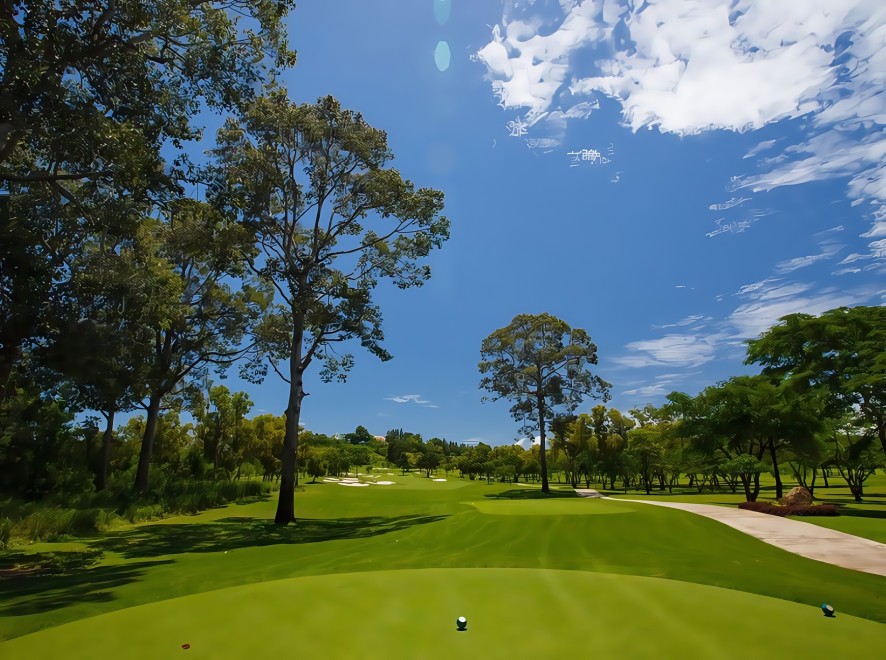
The trees are what define it. Mature tamarind and acacia line the fairways.
More than half a century since 1970. These trees have real height and spread. Miss the fairway off the tee and there will certainly be holes where attacking the green directly is no longer possible.
Playing a course where the trees matter
Blocked by a tree, you have three options: over it, around it, or sideways out.
If you want to protect the score, the moment you hesitate, play sideways out. On a par 4, hit the green with your third and take the bogey. That is enough.
The value of keeping the fairway
In the end, on a course where the trees matter, direction beats distance.
Rather than hitting driver long and crooked, one club less and safely on the fairway produces the better score.
How to build the round
Early holes: learn how the trees behave
What you want to establish over the first few holes is how far off line you have to be before a tree catches you.
Tamarind and acacia spread widely, and even “only slightly off” takes away your options for the second shot. Work out your own margin early.
Middle holes: stay out of the steep bunkers
The 2007 renovation rebuilt the bunkers with steep lips.
Once in, think only about getting out, not about the flag. Do not turn a hole where one clean escape means bogey into a double or worse by forcing it.
Late holes: toward the 18th
The closing stretch is where fatigue arrives. And with the clubhouse coming into view, concentration slips easily.
The 18th is a sweeping dogleg par 5. Whether you can keep laying up to the very end decides how the day’s score finishes.
How to build a score here
- Choose your tee carefully. About 7,162 yards, slope 137. The wrong tee means suffering all the way in.
- Factor the trees in. Mature tamarind and acacia limit the second shot.
- From the steep bunkers, just get out. The 2007 renovation made escaping a matter of technique.
- Check where the new lakes are. The water added in the renovation was not in the original design.
- The greens are tournament standard. Ask your caddie about speed and slope before you read them.
- Do not relax on the 18th. The finishing hole in front of the clubhouse is the last test.
The Old Course is a classic skeleton carrying tournament-standard detail. Against its gentle appearance, the actual difficulty is high. Understanding that gap first is the single best preparation for enjoying the round.
Common mistakes and how to avoid them
1. Choosing the back tees
About 7,162 yards, slope 137. Let “the course the LPGA plays” pull you back to the tips and you will burn through your energy and your patience before the turn. Choose the tee that matches how far you actually hit it.
2. Underestimating the trees
More than fifty years of growth has given the tamarind and acacia wide spread and real height. This is a course where “I can get over that” often turns out to be wrong.
3. Firing at the flag from a steep bunker
The renovated bunkers take technique to escape. Fail to get out and return to the same bunker and the hole alone wrecks the card.
4. Being lulled by the classic look
The tree-lined scenery is gentle, but a course rating of 74.1 is not a gentle number. Drop the assumption that “an old course must be easy”.
5. Forcing the 18th
A dogleg par 5 finishing in front of the clubhouse. Aware of the eyes on the terrace, you will want to go for it in two; a big number on the last hole changes how the whole day reads.
Facilities and services
The clubhouse
According to the official site, the clubhouse has lockers, showers and drying facilities.
The restaurant seats 150 and overlooks the course. The pro shop rents equipment and also carries LPGA merchandise.
Practice facilities
There is a putting green, a chipping area and a natural-grass driving range.
A grass range feels different from mats. Because you can check under the same conditions you will play in, half an hour before your start is time well spent.
Caddies and carts
According to the official site, a caddie is compulsory for every player and a cart is compulsory too, with only club caddies permitted to drive.
Since you are not driving yourself, the time between shots goes into looking at the course and planning the next one.
Location and access
The Old Course is at 50 Village No. 9, Phonprapa Road, Pong, Bang Lamung, Chonburi 20150.
Inland from central Pattaya
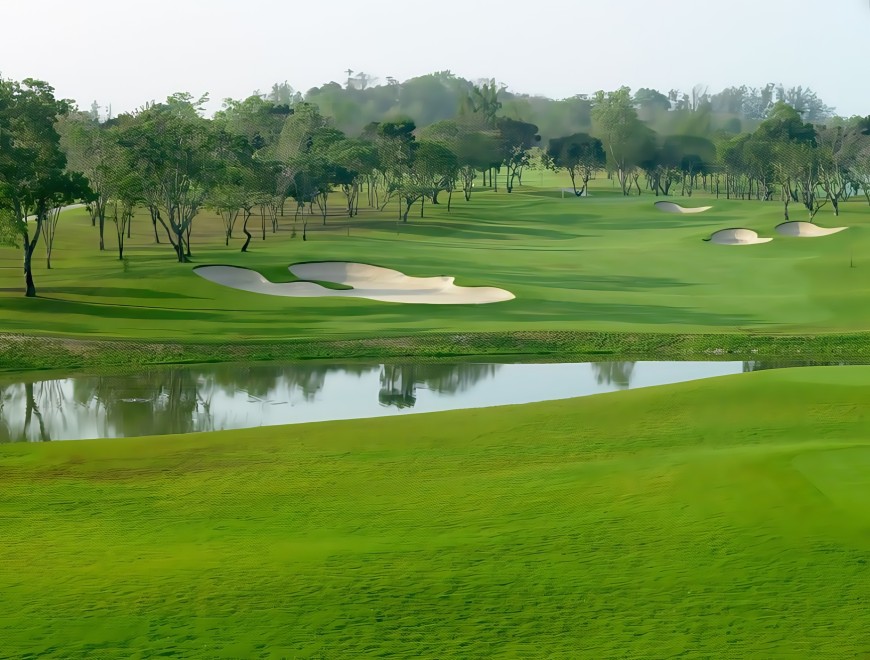
The official site describes the setting as hill country on the outskirts of Pattaya, a short drive inland from the beach area.
If you are staying in Pattaya, it is close enough to play without spending long on the road.
Four courses on one property
Alongside the Old Course, Siam Country Club has Plantation, Waterside and Rolling Hills.
Playing four courses within a single stay is a rare thing even in Thailand. If you are planning several rounds, you can reduce travel to essentially nothing.
Getting there
Beyond a company car or your own vehicle, ride-hailing services such as Grab, common throughout Bangkok, work well. Since it is inland, think about the ride home in advance too. Please note that GoGolf does not arrange transfers or shuttles.
Choosing between the four Siam courses
The four courses within the same club each have their own character. Which one you pick depends on what you are after.
- Old Course: 18 holes, par 72, about 7,162 yards. Opened 1970, renovated 2007. Classic parkland. Choose it for the history and the tournament record.
- Plantation: 27 holes. Schmidt-Curley design, opened 2008. The contours of a former pineapple plantation. Choose it for dramatic elevation change.
- Waterside: 18 holes. IMG design, opened 2014. Gentle undulation and wide fairways. Choose it for water views and openness.
- Rolling Hills: 18 holes, over about 7,200 yards. Schmidt-Curley design, opened 2020. The “Wall of Death” bunker at 15. Choose it for the newest architecture.
What only the Old Course has is more than half a century of time. Mature trees, and a record as an LPGA venue. Neither is something a new course can build.
What to bring
- A lofted wedge — needed to escape the steep-lipped bunkers.
- Spare balls — the renovation added lakes. Carry extras.
- Sunscreen and a hat — essential in the heat and humidity.
Because there is a natural-grass driving range, checking your strike under playing conditions before you start settles the early holes.
Best season and time of day
The dry season from around November to February is the most comfortable, with lower humidity and firmer turf.
The Honda LPGA Thailand has also been held at that time of year. Playing in the same seasonal conditions as the tournament is one reason to choose the dry season.
March to May brings hot afternoons, so a morning slot is the realistic choice. From June to October, most days see a short squall pass through in the afternoon. Morning rounds are barely affected, and tee times are easier to get.
Who this course suits
- Anyone drawn to the history of Thai golf: opened 1970, Thailand’s first privately owned course.
- Anyone wanting a tournament course: course rating 74.1, slope 137. An LPGA venue.
- Anyone who likes classic architecture: tree-lined parkland where direction beats distance.
- Anyone playing several rounds: four courses of different character on one property.
- Anyone staying in Pattaya: hill country inland from town, so travel stays short.
- Anyone interested in how design evolves: an unusual mix of 1970 bones and 2007 detail.
On the other hand, if you are not confident about distance, or on a day when the ball is curving, this course is hard work. In that case play a forward tee and commit to laying up — it remains thoroughly enjoyable.
Pairing it with other Chonburi courses
If you are playing several rounds during your stay, pairing nearby courses keeps travel down.
- Amata Spring Country Club — the island green at 17, reached by boat, is the signature.
- Burapha Golf and Resort — 36 holes; East and West play very differently.
- Chee Chan Golf Resort — the Khao Chi Chan Buddha is visible from every hole.
- Bangpra Golf Club and Resort — a classic course opened in 1958.
Availability and pricing across the whole region are on the Bangkok golf booking page.
Check these before you book
- Which tee you will play — about 7,162 yards, slope 137. Decide with your group’s distance in mind.
- Your tee time — an early start is realistic in the hot season; the dry season matches tournament conditions.
- Which of the four courses — Old, Plantation, Waterside and Rolling Hills share the same club.
- How you will travel — it is inland from central Pattaya. Think about the ride home too.
- Time to warm up — there is a natural-grass driving range. Arriving early is worth it.
- Today’s rates and availability — check the GoGolf app or website.
This is a popular course, so peak dry-season slots fill quickly. Lock one in as soon as your dates are settled.
In summary
Three reasons to choose the Old Course.
- History — opened 1970, designed by Ichisuke Izumi. Thailand’s first privately owned course.
- Tournament record — fully renovated by Schmidt-Curley in 2007 and host of the Honda LPGA Thailand.
- Mature architecture — classic parkland lined with tamarind and acacia, where direction beats distance.
Siam Country Club Pattaya Old Course plays 18 holes, par 72, about 7,162 yards, with a course rating of 74.1 and a slope rating of 137. The original routing was left in place while the detail was raised to tournament standard — classic and modern side by side.
Caddies and carts are compulsory, and the carts are driven by club caddies. Three other courses of different character share the property, which makes it a strong base for playing several rounds. For today’s availability and green fees, check the GoGolf app or website.
Frequently asked questions
Where is Siam Country Club Pattaya Old Course?
How many holes and what par?
Who designed it?
When did it open?
What did the 2007 renovation change?
What tournaments are held here?
What characterises the course?
What is the 18th like?
Is it a difficult course?
Can beginners play here?
What about caddies and carts?
Is there a practice range?
What facilities does the clubhouse have?
How do the four Siam Country Club courses differ?
Can I play several rounds here?
When is the best time to play?
How much does it cost?
Do you offer transfers?
More Golf Courses in Chonburi
Swipe to see more courses →