


Last updated: August 19, 2026
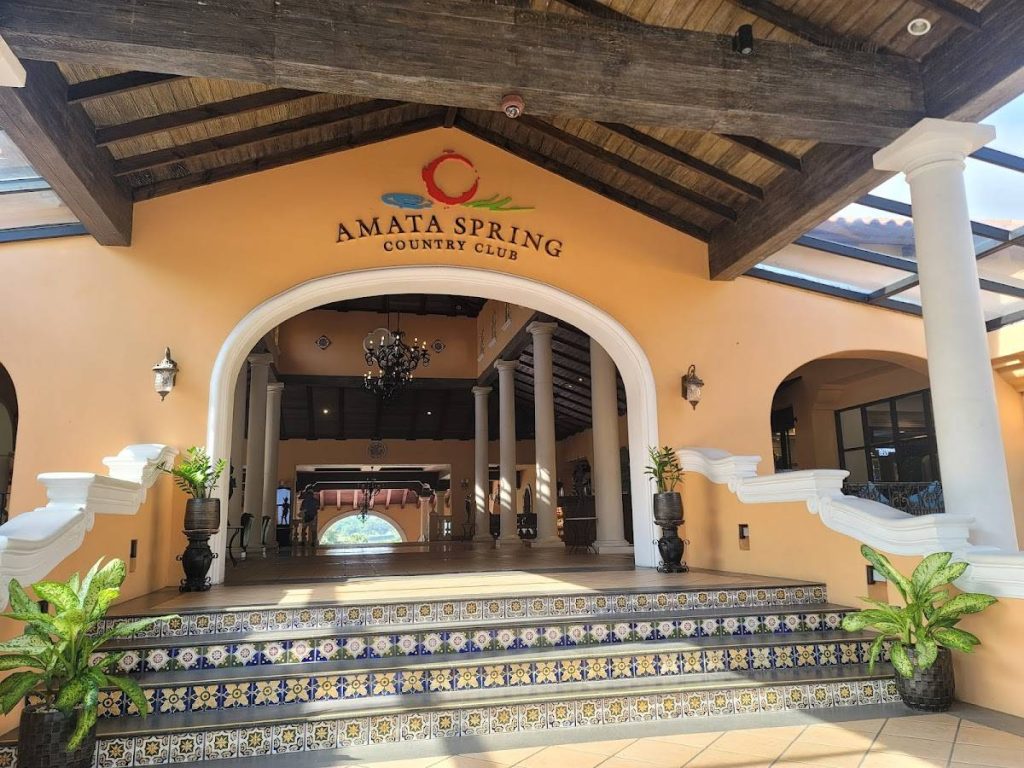
Amata Spring Country Club is an 18-hole, par-72 course inside the Amata Nakorn Industrial Estate in Mueang Chon Buri, Chonburi province. It was designed by Lee Schmidt (Schmidt-Curley Design) and opened in 2005.
It measures about 7,470 yards from the back tees, 6,088 from the club tees and 5,238 from the front. Course ratings are 75.5, 68.8 and 70.7 respectively. 7,470 yards at a rating of 75.5 tells you this course is set up at tournament standard.
The signature is the par-3 17th, an island green. According to Where2Golf the green measures about 40 by 40 yards, carries a small bunker and a palm tree, and is reached by boat.
The club has in fact hosted Asian Tour, European Tour and women’s professional events. As a members’ club, admission conditions vary from day to day. Check today’s tee times and green fees in the GoGolf app or website.

Green fees and booking
Green fees vary by day of the week, public holidays, season and timing. The rates shown on GoGolf reflect these in real time as closely as possible, so please check the GoGolf app or website for current pricing.
Price summary
Green fee + cart, per playerTHB11.500to12.000
| AM from | PM from | |
|---|---|---|
| Weekday | THB 11.500 | THB 11.500 |
| Weekend & holiday | THB 12.000 | THB 12.000 |
Price calendar
21 Oct – 17 Nov 2026 · THBWeekend & holiday rateNo tee timesM = million THB, lowest of each half-day
Book more easily with the GoGolf app


Course information
| Address | 700/3-9 Moo 6, Amata Nakorn Industrial Estate, Nong Mai Daeng, Mueang Chon Buri, Chonburi 20000 |
|---|---|
| Designer | Lee Schmidt (Schmidt-Curley Design) |
| Opened | 2005 |
| Holes | 18 holes, par 72 |
| Length | Back tees about 7,470 yards / club tees about 6,088 / front tees about 5,238 |
| Course rating | Back 75.5 / club 68.8 / front 70.7 |
| Course type | Open parkland over undulating ground |
| Character | Two large lakes with water in play on several holes. Big bunkers that matter on every hole and every approach |
| Greens | Fast and undulating |
| Signature hole | The par-3 17th island green (about 40 by 40 yards, reached by boat) |
| Practice | Rated Excellent |
| Caddies and carts | Carts compulsory. Caddies accompany every player |
| Spikes | Non-metal spikes only |
| Notable tournaments | Asian Tour, European Tour and women’s professional events |
| Visitors | A members’ club. Play is normally with a member |
| Phone | +66 33 141 000 |
| Official website | amataspring.com |
| Green fees | Vary by day, season and time. Check current rates in the GoGolf app or website |
The 17th island green
Talk about Amata Spring and the 17th comes up first.
A green you reach by boat
Where2Golf calls the 17th a par-3 island green, giving the green size as about 40 by 40 yards and noting a small bunker and a palm tree.
And the remarkable part is that you reach the green by boat. Not a bridge you walk across — a boat. It is an unusual arrangement even by world standards, and worth the visit for this hole alone.
Forty yards square
A green of 40 by 40 yards is by no means small for an island green. Unlike the tiny green at TPC Sawgrass’s 17th, there is plenty of area to work with here.
The problem is not the area but the psychological weight of knowing that a miss means water. Even at a distance where hitting a 40-yard square is not hard, the swing changes the moment you think about the water.
How to play it
The way to play an island green is the same everywhere. Don’t go at the pin; put it on the centre of the green. Concentrate only on matching the distance, and switch to a two-putt plan.
With 40 yards square to work with, aiming at the middle absorbs a certain amount of error. Wherever the pin is cut, the middle is aim enough.
Where it sits in the round matters too. On a day when your card is holding together, this tee shot comes with tension attached. Deciding as you leave the 16th that “the 17th is middle of the green, two putts” removes the hesitation when you get to the tee.
Lee Schmidt’s design
Amata Spring was designed by Lee Schmidt, a partner in Schmidt-Curley Design.
The team behind modern Asian golf
Schmidt-Curley Design have worked on many projects across Asia. In Thailand alone, Royal Bang Pa-in in Ayutthaya and several of the Siam Country Club courses in Pattaya are also their work.
They are one of the names you cannot leave out when talking about modern championship golf in Asia.
Bunkers that matter on every hole
Where2Golf describes the bunkering here as “big bunkers that threaten every hole and every approach shot”, noting substantial sand traps around the greens.
The bunkers are not something that shows up occasionally: you have to count them in across all eighteen holes. Off the tee and on the approach alike, checking where the bunkers sit before choosing a club becomes part of the routine.
Two large lakes
The water is arranged as two large lakes and comes into play on several holes. The 17th island green is part of the same water system.
It is not the type of course with water on every hole, so you only need to raise your concentration on the holes that have it. The bunkers, on the other hand, need your attention for all eighteen.
Fast, undulating greens
Where2Golf describes the greens here as fast and undulating.
Hitting the green is not enough
On fast, undulating greens, simply hitting the putting surface is not enough. Which part of it you stop on decides the score.
Leave the ball a long way from the pin, or above a strong slope, and instead of a birdie chance you have a three-putt risk.
Don’t leave yourself downhill
What you most want to avoid on fast greens is a long downhill putt. Misjudge the pace and it runs well past, and the one coming back is hard too.
At the approach stage, aim at the side that leaves you an uphill putt. Thinking in terms of landing short of the pin is itself the way to prevent three-putts.
Putt before you start
The practice facilities are rated Excellent. On a course with fast greens, spending ten minutes on the putting green before you start reliably cuts the early three-putts.
Location and access
Amata Spring is inside the Amata Nakorn Industrial Estate in Mueang Chon Buri, Chonburi province.
Between Bangkok and Pattaya
The location is midway between Bangkok and Pattaya. For travellers and business visitors who want a premium round without a long drive from either the city or the beach resorts, that makes it a strategic option.
Amata Nakorn is one of Thailand’s major industrial estates, with a heavy concentration of manufacturers including Japanese companies. It also works well in the context of business golf on a work trip.
Getting there
Travel by company car or your own car, or use a ride-hailing service such as Grab, which is common in Bangkok. Travel time changes a lot with traffic, so work back from your tee time and leave with margin.
This is a course on the outskirts, so it is worth planning the ride home in advance. Note that GoGolf does not arrange transfers or shuttles.
What tournament standard means
Where2Golf notes that the course has hosted Asian Tour, European Tour and women’s professional events.
A rating of 75.5
The course rating from the back tees is 75.5. That is a number telling you the back tees are set up for low handicappers and competitors.
The club tees, meanwhile, are 68.8 and the front tees 70.7. Move forward and the numbers become realistic in a hurry. Treat your choice of tee as the difficulty setting for this course.
Condition that stands up to competition
Hosting international tournaments means the setup and the maintenance met that standard.
Length, the quality of the greens, the condition of the course. A course that stands up to competition still feels well built when an amateur plays it.
It is a members’ club
Where2Golf lists Amata Spring as a members’ club where play is normally with a member.
Admission conditions vary from day to day, so please check the day’s availability in the GoGolf app or website.
How to think about your score
The key to scoring at Amata Spring is avoiding the bunkers and deciding where on the green to stop.
- Pick the tee that matches your game. Back 7,470 yards at a rating of 75.5; the club tees are 6,088.
- Check the distance to the bunkers every time. They are placed to matter on every hole and every approach.
- Centre of the green on the 17th. With 40 yards square, aiming at the middle absorbs the error.
- Finish on the side that leaves an uphill putt. On fast, undulating greens you want to avoid downhill.
- Use the putting green before you start. The practice facilities are rated Excellent.
- Ask your caddie where the bunkers are. Especially valuable on a first visit.
Undulating ground, and 7,470 yards from the back. On the numbers alone it is a seriously tough course, but choose your tee and the design gives you plenty to enjoy.
Common mistakes, and how to avoid them
1. Going at the pin on the 17th
The most common mistake on an island green. The green is 40 yards square, so aiming at the middle absorbs a certain amount of error. Wherever the pin is cut, the middle is aim enough.
2. Taking the back tees
7,470 yards at a rating of 75.5 is a setup for competitive players. If you normally play the regular tees and choose them here, every shot after the drive is a long club, and the bunkers that matter on every hole come into play far more often.
3. Not checking where the bunkers are
This is bunkering described as threatening every hole and every approach shot. Skip the step of checking where they sit before choosing a club — off the tee or on the approach — and you will be playing out of sand several times a round.
4. Leaving a long downhill putt
On fast, undulating greens, long downhill putts are the main cause of three-putts. At the approach stage, think about the side that leaves you uphill. Landing short of the pin is itself the way to prevent three-putts.
5. Not checking the admission conditions
This is a members’ club where play is normally with a member. Admission conditions vary from day to day, so always check availability before building your plans around it.
Facilities and services
Practice
Where2Golf rates the practice facilities here Excellent.
Fast, undulating greens and bunkers that matter on every hole. Given those two, there is real value in checking your putting and your bunker shots before you start.
Caddies and carts
Carts are compulsory, and a caddie accompanies every player.
From your caddie you can get the distance to the bunkers, the slope and speed of the greens, and the yardage to the water’s edge. On a first visit, ask freely.
The spike rule
Only non-metal spikes may be worn.
The clubhouse
As you would expect from a premium club, the facilities for the time before and after the round are in place. If there is something specific you want to use — the restaurant, the pro shop — it is safest to confirm it when you book.

What to bring
- A sand wedge with bounce — bunkers matter on every hole, so a club that gets you out easily is reassuring.
- Spare balls — several holes have water in play, the 17th island green among them.
- Sunscreen and a hat — essential.
Best season and time of day
The dry season from around November to February is the most comfortable. Humidity drops and the greens hold their condition most steadily.
In the hot season from March to May daytime temperatures climb, so keep your start early. Getting out of bunkers takes energy on this course, which makes choosing the cooler hours matter even more.
In the rainy season from June to October, most days bring a short afternoon squall through. Play in the morning and the effect is small, and tee times are easier to get.
Who this course suits
- Anyone who wants to play an island green: the 17th is reached by boat, unusual even by world standards.
- Competitive players: the back tees rate 75.5, and the club has a professional tournament record.
- Anyone who chooses by architect: a Lee Schmidt (Schmidt-Curley Design) course.
- Anyone who wants to sharpen their bunker play: bunkering that matters on every hole and every approach.
- Business golf on a work trip: it sits inside the Amata Nakorn Industrial Estate.
- Beginners and mid-handicappers: the front tees are about 5,238 yards, so the distance stays manageable.
On the other hand, this is a members’ club where play is normally with a member, so admission conditions vary from day to day. Please note that it is not a course you simply drop in on.
How it differs from the other Chonburi courses
Chonburi province, which includes Pattaya, is the golf region of eastern Thailand. Here is where Amata Spring sits alongside the main courses in the area bookable through GoGolf.
- Amata Spring Country Club: 18 holes / par 72 / about 7,470 yards. Lee Schmidt, opened 2005. The 17th island green reached by boat. A professional tournament record.
- Chee Chan Golf Resort: 18 holes / par 72 / about 7,345 yards. David Dale, opened 2018. Views of the Khao Chi Chan Buddha.
- Burapha Golf and Resort: 36 holes. David Graham & Gary Panks, opened 1993. Two eighteens, East and West.
- Greenwood Golf and Resort: 27 holes. Peter Thomson design, operating since 1993. A parkland-links feel.
- Bangpra Golf Club and Resort: 18 holes / par 72 / about 7,393 yards. Opened 1958. A classic course with mature trees.
What makes Amata Spring distinct in that company is the 17th island green and a tournament-standard setup. Crossing to a green by boat is an experience you can have nowhere else in Thailand.
Combining it with other Chonburi courses
If you are playing several rounds during a stay, pairing nearby courses keeps the travel down.
- Chee Chan Golf Resort — views of the Khao Chi Chan Buddha are its draw.
- Burapha Golf and Resort — 36 holes; East and West have different characters.
- Greenwood Golf and Resort — 27 holes, a Peter Thomson design.
- Bangpra Golf Club and Resort — a classic course that opened in 1958.
Availability and rates for the whole area are on the Bangkok golf booking page.
Summary
In short, there are three reasons to choose Amata Spring.
- The 17th — a par-3 island green you reach by boat. An unusual arrangement even by world standards.
- Design and setup — Lee Schmidt, opened 2005. 7,470 yards from the back at a rating of 75.5.
- Tournament record — it has hosted Asian Tour, European Tour and women’s professional events.
Amata Spring Country Club is 18 holes, par 72. It is built from two large lakes, big bunkers that matter on every hole and every approach, and fast, undulating greens. The club tees drop to about 6,088 yards and the front tees to about 5,238.
As a members’ club, admission conditions vary from day to day. Check today’s tee times and green fees in the GoGolf app or website.
Frequently asked questions
Where is Amata Spring Country Club?
How many holes and what par?
Who designed it and when did it open?
Which is the signature hole?
How should I play the 17th?
What is the course like?
What are the greens like?
Where is the difficulty?
What tournaments has it hosted?
Can visitors play?
Can a beginner play here?
Is there a practice range?
What about caddies and carts?
When is the best season and time of day to play?
How much does it cost?
Is a transfer available?
More Golf Courses in Chonburi
Swipe to see more courses →