


As one of the world’s largest golf equipment manufacturers, TaylorMade has consistently captured the attention of golfers through bold product innovations. One of their most iconic releases is the TaylorMade R11 Driver, which—since debuting in 2011—has become a “driver of the masses” due to its widespread use among amateurs and professionals alike. Its popularity is not a passing trend, but the result of cutting-edge engineering and a distinctive design that made the R11 exceptional in its era and still relevant today. Here is a full review from GoGolf.
TaylorMade R11 Driver Design: A Classic–Modern Fusion That Became Iconic
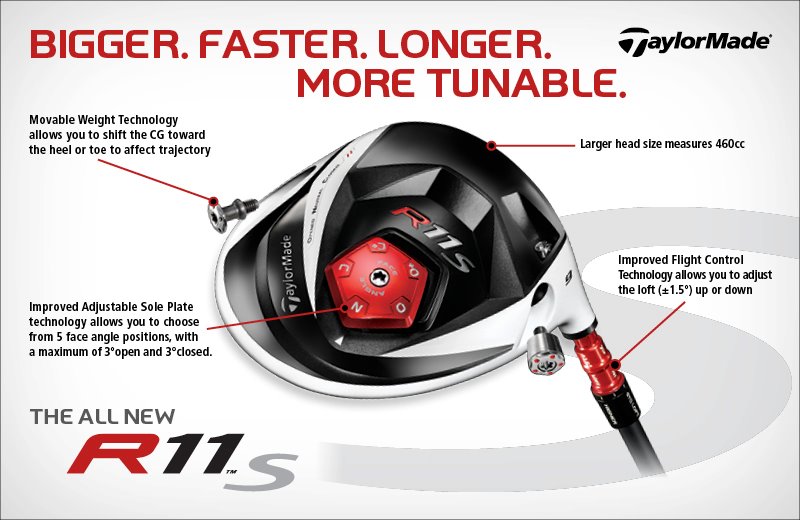
One of the most striking characteristics of the TaylorMade R11 Driver is its instantly recognizable visual design. Unlike most drivers of its time that featured glossy black crowns, the R11 arrived with a matte-white crown and a deep-black clubface. This high-contrast color scheme became a TaylorMade signature but also served a practical psychological purpose during address.
TaylorMade intentionally chose white for the crown to make the head appear larger behind the golf ball, boosting player confidence. The visual contrast also makes the sweet spot appear wider, which can positively influence a golfer’s mindset before swinging. In the world of golf psychology, such details have a real impact on confidence and consistency.
Beyond color, the R11’s head shape carries a clean, classic profile with sharp lines and an aerodynamic silhouette. This streamlined structure reduces drag during the swing, helping golfers generate higher clubhead speed and longer drives.
Officially released on February 4, 2011, the R11 was made available in both right-handed and left-handed models. The clubhead uses a multi-material composite construction, making it strong, durable, and stable even under frequent use in varying course conditions.
Unsurprisingly, the R11 remains praised in countless reviews for its aesthetics and ergonomics. And even as newer models appear each year, many golfers still keep the R11 in their bag because of its familiar feel and timeless visual appeal.
Flight Control Technology (FCT) & Adjustable Sole Plate (ASP): Independent Loft & Face Angle Adjustability
Diving into its technical features, the TaylorMade R11 Driver introduced several groundbreaking technologies. One of the most impactful is Flight Control Technology (FCT)—a hosel system that allows golfers to independently adjust loft by approximately ±1° from the default setting. Loft changes directly influence launch height, carry distance, and overall ball roll on the fairway.
The R11 is also equipped with the Adjustable Sole Plate (ASP), giving golfers the ability to modify face angle into 48 different configurations. Players can choose between neutral, open, or closed positions based on their swing pattern and preferred starting line.
The combination of FCT and ASP creates unmatched flexibility. Loft and face angle can be adjusted independently, unlike older driver designs that changed both simultaneously. For example, a golfer who tends to slice can close the face angle without increasing launch height or altering loft.
This level of adjustability was revolutionary at the time—and remains valuable today—allowing golfers to test multiple setups using just one driver rather than buying several different models.
[ Read also: Bridgestone Tour B XW-1 Wedges Review – Ultra-Premium Wedge Technology ]
Movable Weight Technology (MWT): Personalizing Center of Gravity for Optimized Ball Flight
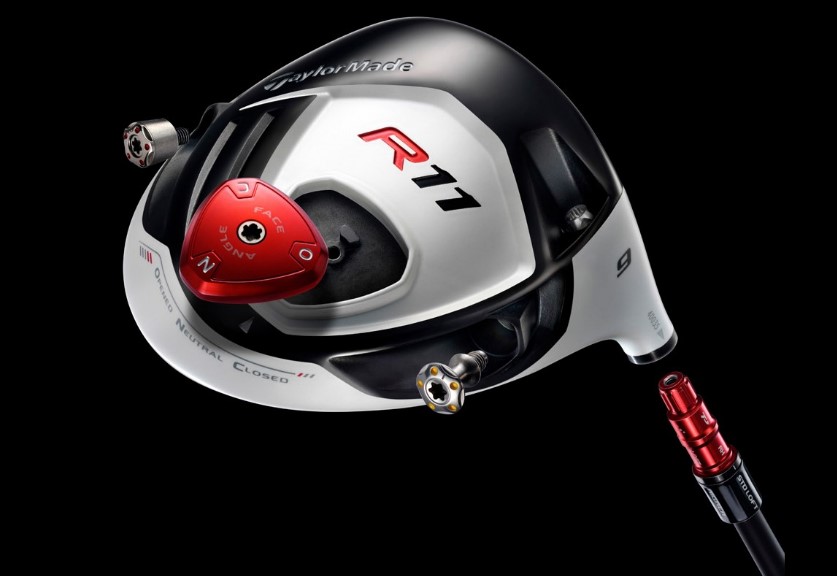
In addition to FCT and ASP, the TaylorMade R11 Driver features Movable Weight Technology (MWT). This system allows golfers to reposition weights on the clubhead to shift the Center of Gravity (CG).
In general:
- Shifting weight toward the heel promotes a draw (right-to-left ball flight for right-handers).
- Shifting weight toward the toe encourages a fade (left-to-right).
This lets golfers “program” their driver based on their swing tendencies or desired shot shape.
MWT doesn’t just adjust curvature—it enhances stability at impact. Golfers can configure the driver for:
- Lower spin and maximum distance, or
- Higher spin for more control and softer landings
For professionals who frequently play in varied course layouts and wind conditions, this technology is incredibly valuable. They can fine-tune their driver before each tournament round, optimizing performance for specific course demands.
Amateurs also benefit greatly from learning how weight distribution affects ball flight. With some experimentation, players can discover a personalized setup that produces more consistent drives.
Standard R11 vs. R11 Tour Preferred (TP): Same Engineering, Different Shaft Profiles
To accommodate golfers with different swing characteristics, TaylorMade released the R11 in two variations: R11 Standard and R11 Tour Preferred (TP).
Both versions share identical clubhead shape and technology. The only difference lies in the shaft:
R11 Standard
- Features mid-flex graphite shafts
- Ideal for golfers with average swing speed
- Provides a blend of forgiveness and stability
R11 TP (Tour Preferred)
- Equipped with premium, heavier, stiffer graphite shafts
- Designed for high swing speed players
- Produces lower spin and enhanced face stability
Professional golfers and low-handicappers gravitate toward the TP version for its tighter feel and more controlled energy transfer. Having these two options makes the R11 suitable for a wide skill range without sacrificing its core adjustability features.
Conclusion: TaylorMade R11 Driver – An Innovative Legend That Still Shines
More than a decade after its debut, the TaylorMade R11 Driver is still found in the bags of many golfers. This longevity proves the R11 was not just a momentary sensation—it was genuinely ahead of its time in both technology and performance.
Its iconic white crown may have grabbed initial attention, but its lasting influence comes from:
- Independent loft and face adjustability (FCT & ASP)
- Movable Weight Technology
- Aerodynamic, confidence-boosting design
- Durable multi-material construction
Together, these features allow golfers to fine-tune their driver without needing professional fitting tools. The R11 is the perfect example of engineering innovation paired with an eye-catching aesthetic.
Even with newer TaylorMade drivers like the Stealth and SIM2 entering the market, the R11 remains beloved because of its familiar feel, consistent performance, and customizable setup.
If you’re looking for a legendary driver that adapts to your swing style and boosts confidence on every tee shot, the TaylorMade R11 remains an outstanding and worthwhile investment—even today.
TaylorMade R11 Driver FAQ: Specs, Technology, Benefits, and Buying Tips
1. What is the TaylorMade R11 Driver?
The TaylorMade R11 Driver is a 2011 golf driver best known for its white crown, black clubface, and advanced adjustability for its era. Its core technologies are Flight Control Technology (FCT), Adjustable Sole Plate (ASP), and Movable Weight Technology (MWT).
2. When was the TaylorMade R11 Driver released?
GoGolf states that the TaylorMade R11 Driver was officially released on February 4, 2011, and Orlando Golf Blogger’s March 2011 review notes that the driver had reached shelves the previous month. In practical terms, it is a TaylorMade 2011 driver model.
3. What are the main TaylorMade R11 Driver specs?
TaylorMade’s official spec sheet lists 9.0° and 10.5° lofts, right- and left-handed availability, 60° lie, 440cc head volume, 45.75-inch length, D4 swing weight, TaylorMade 360 55g grip, and Fujikura Blur 60 or Fujikura Blur TP 65 shaft options.
4. What does Flight Control Technology do?
Flight Control Technology (FCT) is the adjustable hosel system used to change loft or launch angle. TaylorMade’s official material identifies FCT as the loft-adjustment system, while Orlando Golf Blogger explains that it can raise or lower launch angle by about one degree across different positions.
5. What does the Adjustable Sole Plate do?
Adjustable Sole Plate (ASP) changes how the clubface sits at address without changing loft. TaylorMade’s official material describes ASP as the face-angle adjustment feature, and Orlando Golf Blogger says it can open or close the face angle by about two degrees.
6. What does Movable Weight Technology do?
Movable Weight Technology (MWT) lets golfers adjust center-of-gravity location by changing the heel/toe weight setup. TaylorMade describes it as a CG-adjustment feature, while Orlando Golf Blogger explains that different heel and toe weight combinations can promote either draw bias or a more neutral ball flight.
7. Why is the white crown important?
The white non-glare crown and black clubface were designed to improve alignment and make the head look more confidence-inspiring at address. Golf Monthly noted that the 440cc head appears larger because of the white finish and black-face contrast, while TaylorMade’s official material also highlights the white non-glare crown for easy alignment.
8. Is the TaylorMade R11 Driver good for beginners?
It can work for beginners who want to learn how loft, face angle, and weight settings affect ball flight, but the adjustability may feel complex at first. Golf Monthly said the R11’s adjustability seems complicated initially but is easier to set up than previous versions, so beginners should ideally get help from a fitter or experienced golfer.
9. Is the R11 better for experienced golfers?
The R11 is especially appealing to intermediate and advanced golfers because it allows tuning of launch, face angle, and shot shape. GoGolf also explains that the R11 Standard and R11 TP share the same head technology, but the TP version uses heavier, stiffer premium shafts for higher swing-speed players.
10. What is the difference between the TaylorMade R11 and R11 TP?
According to GoGolf, the R11 Standard and R11 TP share the same head and core technology, but differ in shaft profile. The Standard version suits average swing speeds, while the TP version is aimed at faster swingers who want a heavier, stiffer, lower-spin feel.
11. Is the TaylorMade R11 Driver still worth buying now?
Yes, it can still be worth buying as a used driver if you want an iconic, adjustable TaylorMade model at a lower price than most modern drivers. Because it is an older model, buyers should check face condition, crown marks, shaft, grip, movable weights, adapter, and whether the adjustment tool is included.
12. What should you check before buying a used TaylorMade R11 Driver?
Check the loft, shaft flex, head condition, grip, weight screws, adapter, authenticity, and adjustment tool. The R11’s performance depends heavily on correct setup, and Orlando Golf Blogger’s review shows how shaft and setting changes can significantly affect spin, direction, and total distance.